In the evolving biosimilar landscape, patent challenges remain a critical strategy to clear the path for market entry.  Recent reforms at the Patent Trial and Appeal Board (PTAB) under Director John Squires have significantly altered the inter partes reviews (IPRs) landscape, leading to a steep decline in institution rates.  While this shift may initially appear as a hurdle for biosimilar developers seeking to challenge blocking patents, it opens the door to underutilized alternatives like ex parte reexaminations and it increases the criticality of filing post-grant review (PGR) petitions when the opportunity arises (i.e., within 9-months of patent grant).  Here we explore these changes, their impact on biosimilars specifically, and why reexams could emerge as a strategic tool in biosimilars manufacturers’ toolboxes.

PTAB Reforms and the Decline in IPR Institutions

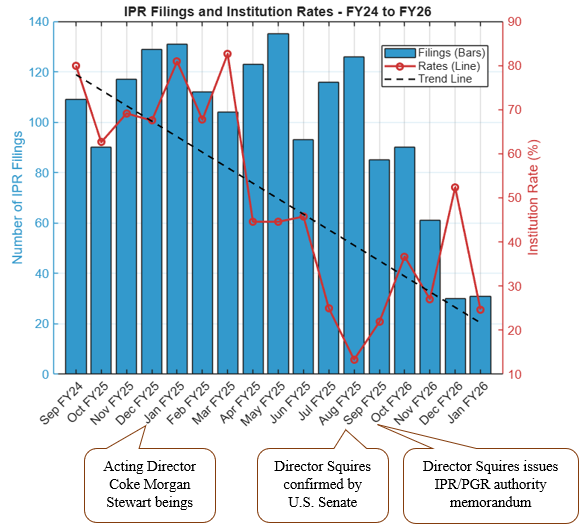
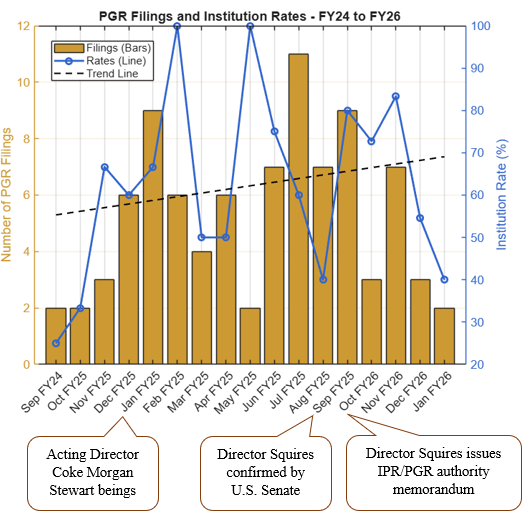
Director Squires implemented procedural changes aimed at enhancing efficiency of PTAB proceedings.  These changes include centralization of institution decisions under his direct oversight (effective October 2025), proposed rules addressing serial petitions, and real-party-in-interest requirements [1].  These reforms have dramatically decreased IPR institution rates initially.  IPR filings declined to 60.4%  of total PTAB petitions in 2025 (down from 73% in 2024), procedural denials surged 630% (i.e., to a record 607), and institution rates plummeted from 65-82% in the first quarter to 15-34% by the third quarter [2].  See FIG. 1 (illustrating drop in instituted IPRs); see also FIG. 2 (illustrating slight increase in instituted PGRs).  A full review of fiscal year 2025 trial statistics at the PTAB can be found on our PTAB Law Blog.

FIG. 1: Demonstration of IPR filings and institution rates from September 2024 through January 2026.  Data for January 2026 were collected through January 25, 2026.  The blue bars depict the number of IPR filings for each month; the red line depicts the institution rate (%), where the institution rate is calculated from the number of petitions instituted divided by the total number of decisions made (instituted and denied), excluding settlements, terminations, pending petitions, etc.  The trend line shows a downward trend of IPR institution rates.  Appended notes depict important dates.  Data collected January 25, 2026, and are available at https://data.uspto.gov/ptab/trials/proceedings.

FIG. 2: Demonstration of PGR filings and institution rates from September 2024 through January 2026.  Data for January 2026 were collected through January 25, 2026.  The yellow bars depict the number of PGR filings for each month; the blue line depicts the institution rate (%), where the institution rate is calculated from the number of petitions instituted divided by the total number of decisions made (instituted and denied), excluding pending petitions.  The trend line shows a slightly upward trend of PGR institution rates.  Appended notes depict important dates.  Data collected January 25, 2026, and are available at https://data.uspto.gov/ptab/trials/proceedings.

Historically, IPRs have been a favored tool for biosimilar applicants under the Biologics Price Competition and Innovation Act (BPCIA), allowing challengers to invalidate key patents efficiently [3, 5].  However, with stricter scrutiny, denials have increased, which may potentially prolong patent disputes and delay biosimilar launches.  Recent analysis suggests that IPR institution rates may be climbing off the recent lows, but the rate remains well below the historical average of roughly 67% [7].

Ex Parte Reexaminations: An Underutilized Avenue for Biosimilar Challengers

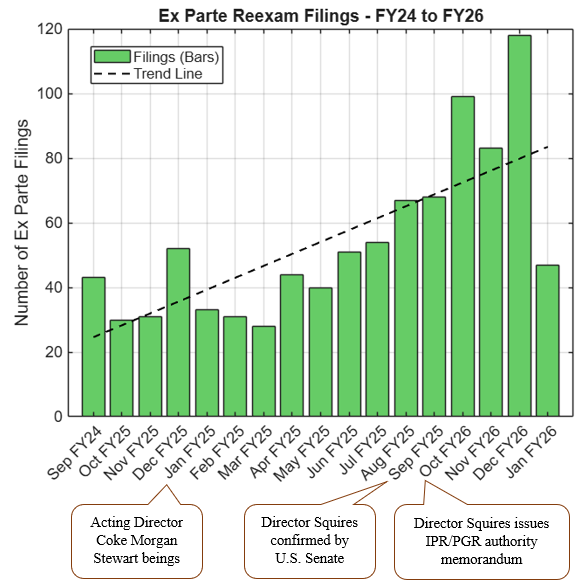
Amid these PTAB changes, ex parte reexaminations stand out as a promising, yet underutilized, alternative to IPRs.  Unlike IPRs, which involve adversarial proceedings (albeit with historically high invalidation rates averaging around 60-70%), ex parte reexams are conducted between the patent owner and an examiner, after the reexamination request is filed by a requester.  While the USPTO grants 95% of ex parte reexam requests (vs. 63% institution for IPRs), reexams have lower claim cancellation rates (only 14%) [4].  Approximately 62% of patents that undergo reexamination end up with modified or canceled claims [4].  Filings for ex parte reexams surged 66.1% to 726 in 2025, likely driven by the IPR institution declines [2].  See FIG. 3:

FIG. 3: Demonstration of ex parte reexamination filings from September 2024 through January 2026.  Data for January 2026 were collected through January 25, 2026.  The green bars depict the number of ex parte reexamination filings for each month.  The trend line shows an upward trend of ex parte reexamination filings.  Appended notes depict important dates.  Data collected January 25, 2026, and are available at https://portal.unifiedpatents.com/exparte/analytics.

For biosimilars developers, an ex parte reexam provides several advantages.  The process is cost-effective (i.e., filing fees are around $6,000 vs. $40,000+ for IPRs), anonymous (i.e., no real-party-of-interest disclosure), and flexible, which allows challenges based on printed publications without estoppel risks in subsequent litigation [4].  In biologic patent disputes, where complex formulations and methods are common, ex parte reexams can target narrow invalidity grounds effectively.  Another key benefit is that challenges based on double patenting are allowed, which can be critical for challenging patents that extend pharmaceutical exclusivity.  However, drawbacks include inability to assert enablement (35 U.S.C. § 112) and eligibility (35 U.S.C. § 101) challenges, and no direct interaction with the examiner after filing the request.  Meanwhile, patentees can conduct examiner interviews, submit expert declarations, amend claims, and argue iteratively.   

Proposed ‘one-and-done’ rules could bar subsequent PTAB challenges if a patent is upheld in reexam or court, potentially bulletproofing it from further challenges [6]. We are closely monitoring developments in regard to this proposal and will continue to provide updates.

The uptick of ex parte reexams could represent an adaptation to patent challenge strategy.  Biosimilar applicants can use them strategically to cancel key claims of blocking patents while minimizing costs and avoiding the uncertainty around IPR institutions.  This underutilized tool provides an alternative avenue for challengers to clear patent thickets blocking biosimilar entry.

Impact on the Biosimilars Patent Landscape

Over the years, the biosimilars market has seen robust growth, with PTAB challenges playing a pivotal role in facilitating competition.  For example, in pharmaceutical disputes, IPRs historically achieved high institution rates (around 73%) and contributed to settlements that enabled earlier market entry [3].  Under the new regime, lower IPR institution rates shift most patent challenges to district courts, rather than faster and cheaper resolutions at the PTAB, unless PGRs and ex parte reexaminations can fill the void.  District court litigations can favor patentees, where patents enjoy a presumption of validity and the standard for proving invalidity is clear and convincing evidence as opposed to the PTAB’s lower standard of a preponderance of the evidence and no presumption of validity.

For biosimilar developers, and for challengers in general, the procedural changes signal a directive from the USPTO to severely limit duplicative or late challenges, favoring recently granted patents.  Medical and pharmaceutical petitions, including those for biologics, remained relatively steady at 12.7% of PTAB activity in 2025, indicating sustained interest despite the uncertainty [2].  Challengers may need to adapt strategies, such as focusing on stronger prior art (e.g., airtight, single grounds) to avoid denial or considering the procedural factors likely to impact institution, such as parallel litigation or real-party-in-interest disclosures.

Looking Ahead

While declining IPR institutions may reshape biosimilar strategies, the situation is likely to lead to a rise in ex parte reexaminations as well as PGRs (when available).  Ex parte reexaminations offer an efficient, low-risk alternative that biosimilar developers should consider, particularly when double patenting-based challenges are available.  These proceedings remain viable under the new regime, and provide alternative pathways to clear patents blocking biosimilar entry.

References

1. USPTO Proposes New Institution Rules and Director Takes Over Merits-Based Institution Decisions, Morgan Lewis.  (available at https://www.morganlewis.com/pubs/2025/10/uspto-proposes-new-institution-rules-and-director-takes-over-merits-based-institution-decisions).

2. Patent Dispute Report: 2025 in Review, Unified Patents.  (available at https://www.unifiedpatents.com/insights/2026/1/13/patent-dispute-report-2025-in-review).

3. Biosimilar Patent Dance: Leveraging PTAB Challenges for Strategic Advantage, Drug Patent Watch.  (available at https://www.drugpatentwatch.com/blog/biosimilar-patent-dance-leveraging-ptab-challenges-for-strategic-advantage/?srsltid=AfmBOopbJSNMW1vtWQXpBWyZmCaOvOLuVZMIDMiZDg53ErL0y3ZRinAs).

4. Ex Parte Reexamination Process, Adibi IP.  (available at https://adibiip.com/ex-parte-reexamination-process/).

5. Cracking the Biosimilar Code: A Deep Dive into Effective IP Strategies, Drug Patent Watch. (available at https://www.drugpatentwatch.com/blog/cracking-the-biosimilar-code-a-deep-dive-into-effective-ip-strategies).

6. The Slow Death of AIA Trials: A Look into the USPTO’s ‘One-and-Done’ Rule Package, IPWatchdog.  (available at https://ipwatchdog.com/2025/12/09/slow-death-aia-trials-one-and-done/).

7. The Thaw Begins?: What’s Driving IPR Institutions Under Director Squires, Patently-O.  (available at https://patentlyo.com/patent/2026/01/driving-institutions-director.html).

Disclaimer: The information contained in this posting does not, and is not intended to, constitute legal advice or express any opinion to be relied upon legally, for investment purposes or otherwise. If you would like to obtain legal advice relating to the subject matter addressed in this posting, please consult with us or your attorney. The information in this post is also based upon publicly available information, presents opinions, and does not represent in any way whatsoever the opinions or official positions of the entities or individuals referenced herein.

  • Many Prolia®/Xgeva® (denosumab) biosimilars approved in 2025 by FDA and EMA.
  • FDA grants first interchangeable status for rapid acting insulin aspart, KristyTM.
  • EMA sets record with 44 biosimilar authorizations in 2025.

Biosimilars continue to make a significant impact on global healthcare.  These products are highly similar to an already-approved reference product, offering a more affordable treatment option without compromising on safety or efficacy.  Regulatory bodies like the European Medicines Agency (EMA) and the U.S. Food and Drug Administration (FDA) play a critical role in shaping their market introduction.  While both agencies share similar goals of ensuring patient safety and promoting access to high-quality therapeutics, their regulatory pathways and approval trends show notable differences.

One such difference is that the EMA has historically been quicker than the FDA in approving biosimilars.  Since 2005, the biosimilar regulatory framework in Europe has been implemented through the Committee for Medicinal Products for Human Use (CHMP) under the EMA.  The CHMP provides initial assessments for marketing authorization of new medicines that are ultimately approved centrally by the EMA.  Since Sandoz’s somatotropin biosimilar, Omnitrope®, was first authorized on April 12, 2006, an additional 161 applications have been approved in Europe.  Twenty of the authorizations have been withdrawn post-approval (Table 1).  On average, the EMA takes about 1-2 years from submission of a biosimilar application to approval.

In contrast, the FDA’s biosimilar approval process has been relatively slow, with initial approval times averaging 3-4 years for the first generation of biosimilars.  This delay in approval is partly due to the FDA’s more rigorous evaluation of biosimilars and the additional data required to achieve interchangeability designation.  Additionally, the U.S. did not implement a regulatory framework for biosimilar evaluation until after enactment of the Biologics Price Competition and Innovation Act (BPCIA) of 2009.  As the EMA had already approved over a dozen biosimilars by this time, Europe had a significant head start on both the number of approved biosimilars and the regulatory process for approving more.  Sandoz’s filgrastim biosimilar, Zarxio®, received the first U.S. approval in 2015, whereas nine filgrastim biosimilars have been approved in Europe dating back to multiple authorizations in 2008.  Despite the FDA’s relatively slower biosimilar approval pace, the U.S. biosimilar market has managed to grow continuously over the past decade.  Subsequent to Zarxio®’s approval, 89 other biosimilar drugs have gained U.S. approval to date including 25 interchangeable products (Table 2). 

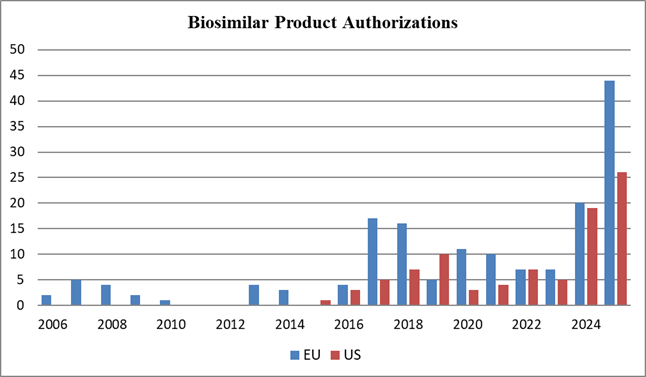
As illustrated in the following graph, the EU’s significant head start and higher approval rate led to an imbalance in the number of biosimilar drugs available in the respective markets, and this imbalance was amplified in the past year.  In 2025 alone, the EMA authorized a record 44 biosimilars, far outpacing the 26 approvals granted by the FDA.  However, in October 2025, the FDA released updated guidance for biosimilars that aims to reduce unnecessary clinical testing and accelerate biosimilar development, so it’s possible the FDA may keep pace with EMA approvals in the future.

For biosimilar approvals, 2025 was the year of denosumab.  In the U.S., eight biosimilars were approved for both Prolia® (60 mg pre-filled syringe) and Xgeva® (120 mg vial).  In the EU, 12 biosimilars were approved for each product, making denosumab the antibody with the most biosimilars approved to date.  Additional highlights for the year 2025 include the FDA’s approval of Omylco® (omalizumab), the first biosimilar of Xolair®, which achieved interchangeability designation, and KristyTM, the first, and thus far only, rapid-acting insulin aspart biosimilar to achieve interchangeability status with the reference product NovoLog®.

Looking forward, there are currently only 14 biosimilar applications under review by the EMA for marketing authorization (Table 3).  However, as an increasing number of patents expire on biologic drugs, this number is expected to increase.  Additionally, the number of abbreviated biologics license applications at the FDA is expected to increase as the primary patents for some blockbuster drugs, such as Keytruda®, expire soon in the U.S. (Table 4).  

Table 1. European Medicines Agency List of Approved Biosimilar Drugs.

Biosimilar Proprietary NameDrug ProductOwnerStatusAuthorization/ Withdrawal Date
Abasaglar
(previously Abasria)
Insulin GlargineEli Lilly Regional
Operations GmbH
Authorized9/9/2014
AbevmyBevacizumabMylan IRE Healthcare LimitedAuthorized4/21/2021
AbseamedEpoetin AlfaMedice Arzneimittel Pütter GmbH & Co. KgAuthorized8/28/2007
AbsimkyUstekinumabAccord Healthcare LtdAuthorized
Withdrawn
12/12/2024 12/15/2025
AccofilFilgrastimAccord Healthcare LtdAuthorized9/18/2014
AdmelogInsulin lisproSanofiAuthorized5/19/2017
AfivegAfliberceptSTADA Arzneimittel AGAuthorized8/18/2025
AfqlirAfliberceptSandozAuthorized11/13/2024
AhzantiveAfliberceptFormycon AGAuthorized1/13/2025
AlpheonRecombinant Human
Interferon Alfa-2a
Biopartners GmbHRefused
AlymsysBevacizumabMabxience Research SLAuthorized3/26/2021
AmgevitaAdalimumabAmgen EuropeAuthorized3/22/2017
AmsparityAdalimumabPfizer Europe MA EEIGAuthorized2/13/2020
AvtozmaTocilizumabCelltrionAuthorized2/14/2025
AvziviBevacizumabFGK Representative Service GmbHAuthorized7/26/2024
AybintioBevacizumabSamsung Bioepis NL B.V.Authorized8/20/2020
BaiamaAfliberceptFormycon AGAuthorized1/13/2025
BekemvEculizumabAmgen Technology UCAuthorized4/19/2023
BemfolaFollitropin AlfaGedeon Richter Plc.Authorized3/27/2014
BenepaliEtanerceptSamsung Bioepis
Uk Limited (Sbuk)
Authorized1/14/2016
BildyosDenosumabSciencepharmaAuthorized9/17/2025
BilprevdaDenosumabSciencepharmaAuthorized9/17/2025
BinocritEpoetin AlfaSandoz GmbHAuthorized8/28/2007
BiograstimFilgrastimAbz-Pharma GmbHAuthorized
Withdrawn
9/15/2008
9/23/2015
BlitzimaRituximabCelltrionAuthorized7/13/2017
BoomyntraDenosumabFresenius Kabi Deutschland GmbHAuthorized7/17/2025
ByoovizRanibizumabSamsung BioepisAuthorized8/18/2021
ConexxenceDenosumabFresenius Kabi Deutschland GmbHAuthorized7/18/2025
CyltezoAdalimumabBoehringer Ingelheim International GmbHAuthorized
Withdrawn
11/10/2017
1/15/2019
DazublysTrastuzumabCuraTeQ BiologicsAuthorized6/30/2025
DegevmaDenosumabTeva GmbHAuthorized11/17/2025
DenbrayceDenosumabMabxience Research SLAuthorized6/26/2025
Denosumab IntasDenosumabIntasAuthorized11/17/2025
DyrupegPegfilgrastimCuraTeQ BoilogiceAuthorized3/28/2025
EiyzeyAfliberceptZaklady Farmaceutyczne PolpharmaAuthorized8/14/2025
EksunbiUstekinumabSamsung Bioepis NL B.V.Authorized
Withdrawn
9/12/2024
8/19/2025
EnwylmaDenosumabZentiva k.s.Authorized6/26/2025
Epoetin Alfa HexalEpoetin AlfaHexal AgAuthorized8/28/2007
EpysqliEculizumabSamsung Bioepis NL B.V.Authorized5/26/2023
EquidacentBevacizumabCentus Biotherapeutics Europe LimitedAuthorized
Withdrawn
9/25/2020
10/11/2021
ErelziEtanerceptSandoz GmbHAuthorized6/23/2017
EvfraxyDenosumabBiosimilar Collaborations Ireland LimitedAuthorized6/30/2025
EydenzeltAfliberceptCelltrionAuthorized2/12/2025
EyluxviAfliberceptBiolitec pharma LimitedAuthorized9/15/2025
Filgrastim HexalFilgrastimHexal AgAuthorized6/2/2009
Filgrastim ratiopharmFilgrastimRatiopharm GmbHAuthorized
Withdrawn
9/15/2008
4/20/2011
FlixabiInfliximabSamsung Bioepis
Uk Limited (SBUK)
Authorized5/26/2016
FulphilaPegfilgrastimMylan S.A.S.Authorized11/20/2018
FymskinaUstekinumabFormycon AGAuthorized9/25/2024
GobivazGolimumabAdvanz Pharma LimitedAuthorized11/17/2025
GrastofilFilgrastimApotex Europe BvAuthorized
Withdrawn
10/18/2013
1/13/2025
GrasustekPegfilgrastimJuta Pharma GmbHAuthorized4/26/2019
HalimatozAdalimumabSandoz GmbHAuthorized
Withdrawn
7/26/2018
12/18/2020
HefiyaAdalimumabSandoz GmbHAuthorized7/26/2018
HerwendaTrastuzumabSandoz GmbHAuthorized11/15/2023
HerzumaTrastuzumabCelltrion Healthcare Hungary Kft.Authorized2/9/2018
HukyndraAdalimumabStada Arzneimittel AGAuthorized11/15/2021
HulioAdalimumabMylan S.A.S.Authorized9/19/2018
HyrimozAdalimumabSandoz GmbHAuthorized7/26/2018
IdacioAdalimumabFresenius Kabi Deutschland GmbHAuthorized4/2/2019
ImraldiAdalimumabSamsung Bioepis UK Limited (SBUK)Authorized8/24/2017
ImuldosaUstekinumabAccord Healthcare S.L.U.Authorized12/12/2024
InflectraInfliximabHospira Uk LimitedAuthorized9/10/2013
InhixaEnoxaparin SodiumTechdow Europe AbAuthorized9/15/2016
InpremziaInsulin humanBaxter Holding B.V.Authorized
Withdrawn
4/25/2022
4/20/2023
Insulin aspart SanofiInsulin aspartateSanofiAuthorized7/26/2020
Insulin lispro SanofiInsulin lisproSanofiAuthorized7/19/2017
ItuxrediRituximabReddy HoldingAuthorized9/19/2024
IzambyDenosumabMabxience Research SLAuthorized6/26/2025
JubbontiDenosumabSandoz GmbHAuthorized5/16/2024
JubereqDenosumabAccord Healthcare S.L.U.Authorized5/26/2025
JunodDenosumabGedeon Richter Plc.Authorized6/23/2025
KanjintiTrastuzumabAmgen/AllerganAuthorized5/16/2018
KaulivTeriparatideStrides Pharma LimitedAuthorized1/12/2023
KefdensisDenosumabStada Arzneimittel AGAuthorized11/17/2025
Kirsty (previously Kixelle)Insulin aspartMylanAuthorized2/8/2021
KromeyaAdalimumabFresenius Kabi Deutschland GmbHAuthorized
Withdrawn
4/2/2019
12/17/2019
LextemyBevacizumabMylan IRE Healthcare LimitedAuthorized
Withdrawn
4/21/2021
6/21/2021
LibmyrisAdalimumabStada Arzneimittel AGAuthorized11/12/2021
LivogivaTeriparatideTheramex Ireland LimitedAuthorized8/27/2020
LusdunaInsulin GlargineMerck Sharp &
Dohme Limited
Authorized
Withdrawn
4/1/2017
10/29/2018
LyumjevInsulin lisproEli Lilly Nederland B.V.Authorized3/24/2020
MovymiaTeriparatideStada Arzneimittel AgAuthorized1/11/2017
MvasiBevacizumabAmgen Europe B.V.Authorized1/15/2018
MynzepliAfliberceptAdvanz Pharma LimitedAuthorized8/18/2025
NepextoEtanerceptMylan and LupinAuthorized6/4/2020
NivestimFilgrastimHospira Uk LtdAuthorized6/8/2010
NyvepriaPegfilgrastimPfizer Europe MA EEIGAuthorized11/18/2020
ObodenceDenosumabSamsung BioepisAuthorized2/12/2025
OgivriTrastuzumabViatrisAuthorized12/12/2018
OmlycloOmalizumabCelltrion Healthcare Hungary Kft,Authorized5/16/2024
OmnitropeSomatropinSandoz GmbHAuthorized4/12/2006
OnbevziBevacizumabSamsung Bioepis Co., Ltd.Authorized
Withdrawn
1/13/2021
10/24/2024
OntruzantTrastuzumabSamsung Bioepis Co., Ltd.Authorized11/17/2017
OpuvizAfliberceptSamsung Bioepis NL B.V.Authorized9/19/2024
OsenveltDenosumabCelltrionAuthorized2/14/2025
OsvyrtiDenosumabAccord Healthcare S.L.U.Authorized5/26/2025
OtulfiUstekinumabFresenius Kabi Deutschland GmbHAuthorized9/25/2024
OvaleapFollitropin AlfaTeva Pharma B.V.Authorized9/27/2013
OyavasBevacizumabSTADA Arzneimittel AGAuthorized3/26/2021
PavbluAfliberceptAmgenAuthorized4/04/2025
Pegfilgrastim Mundipharma (Cegfila)PegfilgrastimMundipharma Biologics S.L.Authorized12/19/2019
PelgrazPegfilgrastimAccord Healthcare LimitedAuthorized9/25/2018
PelmegPegfilgrastimCinfa Biotech S.L.Authorized11/20/2018
PonlimsiDenosumabTeva GMBHAuthorized11/17/2025
PyzchivaUstekinumabSamsung Bioepis NL B.V.Authorized4/19/2024
QoyvolmaUstekinumabCelltrion Healthcare Hungary Kft.Authroized6/02/2025
QutavinaTeriparatideEuroGenerics Holdings BVAuthorized
Withdrawn
8/31/2020
11/26/2020
Ranibizumab Midas (Epruvy)RanibizumabMidas Pharma GmbHAuthorized9/19/2024
RanivisioRanibizumabMidas Pharma GmbHAuthorized8/25/2022
RatiograstimFilgrastimRatiopharm GmbHAuthorized9/15/2008
RemsimaInfliximabCelltrion Healthcare
Hungary Kft.
Authorized9/10/2013
RetacritEpoetin ZetaHospira Uk LimitedAuthorized12/18/2007
RimmyrahRanibizumabQilu Pharma Spain S.L.Authorized1/05/2024
RitemviaRituximabCelltrionAuthorized
Withdrawn
7/13/2017
6/21/2021
Rituzena (previously Tuxella)RituximabCelltrionAuthorized
Withdrawn
7/13/2017
4/12/2019
RixathonRituximabSandoz GmbHAuthorized6/15/2017
RiximyoRituximabSandoz GmbHAuthorized6/15/2017
RolcyaDenosumabSandoz GmbHAuthorized7/17/2025
RuxienceRituximabPfizer Europe MA EEIGAuthorized4/1/2020
SemgleeInsulin glargineMylan S.A.S.Authorized3/27/2018
SilapoEpoetin ZetaStada Arzneimittel AgAuthorized12/18/2007
SkojoyAfliberceptAmgenWithdrawn3/04/2025
SolumarvInsulin HumanMarvel Lifesciences LtdRefused
SolymbicAdalimumabAmgen EuropeAuthorized
Withdrawn
3/22/2017
6/15/2018
SondelbayTeriparatideAccord Healthcare S.L.U.Authorized3/24/2022
SteqeymaUstekinumabCelltrion Healthcare Hungary Kft.Authorized8/22/2024
StimufendPegfilgrastimFresenius Kabi Deutschland GmbHAuthorized3/28/2022
StobocloDenosumabCelltrionAuthorized2/14/2025
TerrosaTeriparatideGedeon Richter Plc.Authorized1/4/2017
TevagrastimFilgrastimTeva GmbHAuthorized9/15/2008
ThorinaneEnoxaparin SodiumPharmathen S.A.Authorized
Withdrawn
9/15/2016
10/24/2019
Tocilizumab STADA (previously Tofidence)TocilizumabSTADA Arzneimittel AGAuthorized6/20/2024
TrazimeraTrastuzumabPfizerAuthorized7/26/2018
Truvelog Mix 30Insulin aspartSanofi Winthrop IndustrieAuthorized4/25/2022
TruximaRituximabCelltrion Healthcare
Hungary Kft.
Authorized2/17/2017
TuznueTrastuzumabPrestige Biopharma BelgiumAuthorized9/19/2024
TyenneTocilizumabFresenius Kabi Deutschland GmbHAuthorized9/15/2023
TyrukoNatalizumabSandoz GmbHAuthorized9/22/2023
UdenycaPegfilgrastimCoherus/ERA Consulting GmbHAuthorized
Withdrawn
9/25/2018
2/4/2021
UsgenaUstekinumabStada Arzneimittel AGAuthorized11/17/2025
UsrentyUstekinumabBiosimilar Collaborations Ireland LimitedAuthorized9/17/2025
UsymroUstekinumabGedeon Richter Plc.Authorized8/14/2025
UzpruvoUstekinumabStada ArzneimittelAuthorized1/05/2024
VegzelmaBevacizumabCelltrion HealthcareAuthorized8/17/2022
VevzuoDenosumabBiosimilar Collaborations Ireland LimitedAuthorized6/25/2025
VgenfliAfliberceptZaklady Farmaceutyczne PolpharmaAuthorized8/14/2025
VivlipegPegfilgrastimBiosimilar Collaborations Ireland LimitedAuthorized8/18/2025
WezenlaUstekinumabAmgen Technology UCAuthorized6/20/2024
WyostDenosumabSandoz GmbHAuthorized5/17/2024
XbrykDenosumabSamsung BioepisAuthorized2/15/2025
XimluciRanibizumabSTADA Arzneimittel AGAuthorized3/26/2022
YaxwerDenosumabGedeon Richter Plc.Authorized6/23/2025
YesafiliAfliberceptBiosimilar Collaborations Ireland LimitedAuthorized7/20/2023
YesintekUstekinumabBioconAuthorized2/14/2025
YuflymaAdalimumabCelltrion Healthcare
Hungary Kft.
Authorized2/11/2021
ValtropinSomatropinBiopartners GmbHAuthorized
Withdrawn
4/24/2006
5/10/2012
ZadenviDenosumabZentiva k.s.Authorized6/26/2025
ZarzioFilgrastimSandoz GmbHAuthorized2/6/2009
ZefyltiFilgrastimCuraTeQ BiologicsAuthorized2/12/2025
ZercepacTrastuzumabAccord Healthcare S.L.U.Authorized7/28/2020
ZesslyInfliximabSandoz GmbHAuthorized5/18/2018
ZiextenzoPegfilgrastimSandoz GmbHAuthorized11/22/2018
ZirabevBevacizumabPfizerAuthorized2/14/2019
ZvograDenosumabStada Arzneimittel AGAuthorized11/17/2025

Table 2. U.S. Food and Drug Administration List of Approved Biosimilar Drugs.

No.Drug Product CompanyReference Product and SponsorMarketing StatusFDA Approval Date
90Boncresa® (denosumab-mobz)Amneal PharmaceuticalsAmgen Prolia®Not Available12/22/2025
89Oziltus® (denosumab-mobz)Amneal PharmaceuticalsAmgen Xgeva®Not Available12/22/2025
88Nufymco® (ranibizumab-leyk)FormyconGenentech Lucentis®Not Available12/18/2025
87Armlupeg (pegfilgrastim-unne)LupinAmgen Neulasta®Not Available11/28/2025
86Poherdy® (pertuzumab-dpzb)Shanghai Henlius BiotechGenentech Perjeta®Not Available11/13/2025
85Osvyrti® (denosumab-desu)Accord BiopharmaAmgen Prolia®Not Available10/29/2025
84Jubereq® (denosumab-desu)Accord BiopharmaAmgen Xgeva®Not Available10/29/2025
83Eydenzelt® (aflibercept-boav)CelltrionRegeneron Eylea®Not Available Launch Expected December 202710/02/2025
82Enoby (denosumab-qbde)Hikma PharmaceuticalsAmgen Prolia®Launched January 20269/26/2025
81Xtrenbo (denosumab-qbde)Hikma PharmaceuticalsAmgen Xgeva®Launched January 20269/26/2025
80Aukelso (denosumab-kyqq)Biocon BiologicsAmgen Prolia®Launched October 20259/16/2025
79Bosaya (denosumab-kyqq)Biocon BiologicsAmgen Xgeva®Launched October 20259/16/2025
78Bidyos® (denosumab-nxxp)Shanghai Henlius BiotechAmgen Prolia®Not Available8/29/2025
77Bilprevda® (denosumab-nxxp)Shanghai Henlius BiotechAmgen Xgeva®Not Available8/29/2025
76KristyTM (insulin aspart-xjhz)Biocon BiologicsNovo Nordisk Novolog®Not Available7/15/2025
75StarjemzaTM (ustekinumab-hmny)Bio-thera SolutionsJanssen Stelara®Launched November 20255/22/2025
74JobevneTM (bevacizumab-nwgd)Biocon BiologicsGenentech Avastin®Available4/09/2025
73Bomyntra® (denosumab-bnht)Fresenius KabiAmgen Xgeva®Launched July 20253/25/2025
72Conexxence® (denosumab-dbnht)Fresenius KabiAmgen Prolia®Launched July 20253/25/2025
71Omlyclo® (omalizumab-igec)CelltrionGenentech Xolair®Not Available Launch Expected September 20263/07/2025
70Stoboclo® (denosumab-bmwo)CelltrionAmgen Prolia®Launched July 20252/28/2025
69Osenvelt® (denosumab-bmwo)CelltrionAmgen Xgeva®Launched July 20252/28/2025
68MerilogTM (insulin aspart-szjj)Sanofi-AventisNovo Nordisk Novolog®Not Available  2/14/2025
67XbrykTM (denosumab-dssb)Samsung BioepisAmgen Xgeva®Not Available2/13/2025
66OspomyvTM (denosumab-dssb)Samsung BioepisAmgen Prolia®Not Available2/13/2025
65Avtozma® (tocilizumab-anoh)CelltrionGenentech Actemra®Launched October 20251/30/2025
64Steqeyma® (Ustekinumab-stba)CelltrionJanssen Stelara®Launched March 202512/17/2024
63YesintekTM (ustekinumab-kfce)Biocon Biologics Inc.Janssen Stelara®Launched February 202511/29/2024
62Imuldosa® (ustekinumab-srlf)Accord BiopharmaJanssen Stelara®Launched August 202510/10/2024
61Otulfi® (ustekinumab-aauz)Fresenius KabiJanssen Stelara®Launched March 20259/27/2024
60Pavblu® (aflibercept-ayyh)AmgenRegeneron Eylea®Launched October 20248/23/2024
59EnzeevuTM (aflibercept-abzv)SandozRegeneron Eylea®Not Available8/09/2024
58Epysqli® (eculizumab-aagh)Samsung BioepisAlexion Soliris®Launched April 20257/19/2024
57Ahzantive® (aflibercept-mrbb)Formycon AGRegeneron Eylea®Not Available6/28/2024
56Nypozi® (filgrastim-txid)Tanvex BiopharmaAmgen Neupogen®Not Available6/28/2024
55Pyzchiva® (ustekinumab-ttwe)Samsung BioepisJanssen Stelara®Launched February 20256/28/2024
54Bkemv® (eculizumab-aeeb)AmgenAlexion Soliris®Launched March 20255/28/2024
53YesafiliTM (aflibercept-jbvf)Biocon BiologicsRegeneron Eylea®Not Available Launch Expected July 20265/20/2024
52OpuvizTM (aflibercept-yszy)Samsung BioepisRegeneron Eylea®Not Available Launch Delayed to 20265/20/2024
51Hercessi® (trastuzumab-strf)Accord BiopharmaGenentech Herceptin®Launched November 20244/25/2024
50Selarsdi® (ustekinumab-aekn)AlvotechJanssen Stelara®Launched February 20254/16/2024
49Tyenne® (tocilizumab-aazg)Fresenius KabiGenentech Actemra®Launched April 20243/05/2024
48Jubbonti® (denosumab-bbdz)SandozAmgen Prolia®Launched June 20253/05/2024
47Wyost® (denosumab-bbdz)SandozAmgen Xgeva®Launched June 20253/05/2024
46Simlandi® (adalimumab-ryvk)AlvotechAbbVie Humira®Launched May 20242/23/2024
45Avzivi® (bevacizumab-tnjn)Bio-thera SolutionsGenentech Avastin®Not Available12/06/2023
44WezlanaTM (ustekinumab-auub)AmgenJanssen Stelara®Launched January 202510/31/2023
43Tofidence® (tocilizumab-bavi)BiogenGenentech Actemra®Launched May 20249/29/2023
42Tyruko® (natalizumab-sztn)SandozBiogen Tysabri®Launched February 20248/24/2023
41Yuflyma® (adalimumab-aaty)CelltrionAbbVie Humira®Launched July 20235/23/2023
40Idacio® (adalimumab-aacf)Fresenius KabiAbbVie Humira®Launched July 202312/13/2022
39Vegzelma® (bevacizumab-adcd)CelltrionGenentech Avastin®Launched April 20239/27/2022
38Stimufend® (pegfilgrastim-fpgk)Fresenius KabiAmgen Neulasta®Launched February 20239/01/2022
37Cimerli® (ranibizumab-eqrn)SandozGenentech Lucentis®Launched October 20228/02/2022
36Fylnetra® (pegfilgrastim-pbbk)Kashiv BiosciencesAmgen Neulasta®Launched May 20235/26/2022
35Alymsys® (bevacizumab-maly)AmnealGenentech Avastin®Launched October 20224/13/2022
34Releuko® (filgrastim-ayow)Kashiv Biosciences & Amneal PharmaceuticalsAmgen Neupogen®Launched November 20222/28/2022
33Yusimry® (adalimumab-aqvh)CoherusAbbVie Humira®Launched July 2023  12/20/2021
32Rezvoglar® (insulin glargine-aglr)Eli LillySanofi Lantus®Launched April 2023  12/20/2021
31Byooviz® (ranibizumab-nuna)Samsung Bioepis and BiogenGenentech Lucentis®Launched July 20229/17/2021
30Semglee® (insulin glargine-yfqn) INTERCHANGEABLEViatris and Biocon BiologicsSanofi Lantus®Launched November 20217/28/2021
29RiabniTM (rituximab-arrx)AmgenBiogen and Genentech Rituxan®Launched January 202112/17/2020
28Hulio (adalimumab-fkjp)MylanAbbVie Humira®Launched July 20237/6/2020
27Nyvepria® (pegfilgrastim-apgf)PfizerAmgen Neulasta®Launched January 20216/10/2020
26Avsola® (infliximab-axxq)AmgenJanssen Remicade®Launched July 202012/6/2019
25AbriladaTM (adalimumab-afzb)PfizerAbbVie Humira®Launched November 202311/15/2019
24Ziextenzo® (pegfilgrastim-bmez)SandozAmgen Neulasta®Launched November 201911/4/2019
23HadlimaTM (adalimumab-bwwd)Samsung BioepisAbbVie Humira®Launched July 20237/23/2019
22Ruxience® (rituximab-pvvr)PfizerBiogen and Genentech Rituxan®Launched January 20207/23/2019
21ZirabevTM (bevacizumab-bvzr)PfizerGenentech/Roche Avastin®Launched December 20196/28/2019
20Kanjinti® (trastuzumab-anns)AmgenRoche/Genentech Herceptin®Launched July 20196/13/2019
19Eticovo® (etanercept-ykro)Samsung BioepisAmgen Enbrel®

Not available4/25/2019
18Trazimera® (trastuzumab-qyyp)PfizerRoche/Genentech Herceptin®Launched February 20203/11/2019
17Ontruzant® (trastuzumab-dttb)Samsung BioepisRoche/Genentech Herceptin®Launched April 20201/18/2019
16Herzuma® (trastuzumab-pkrb)Celltrion and TevaRoche/Genentech Herceptin®Launched March 202012/14/2018
15Truxima® (rituximab-abbs)Celltrion and TevaBiogen and Genentech Rituxan®Launched November 201911/28/2018
14Udenyca® (pegfilgrastim-cbqv)Coherus BioSciencesAmgen Neulasta®Launched January 201911/2/2018
13Hyrimoz® (adalimumab-adaz)SandozAbbVie Humira®Launched July 202310/30/2018
12Nivestym® (filgrastim-aafi)PfizerAmgen Neupogen®Launched October 20187/20/2018
11Fulphila® (pegfilgrastim-jmdb)Mylan/BioconAmgen Neulasta®Launched July 20186/4/2018
10Retacrit® (epoetin alfa-epbx)PfizerJanssen Procrit®Launched November 20185/15/2018
9Ixifi® (infliximab-qbtx)PfizerJanssen Remicade®Not Available12/13/2017
8Ogivri® (trastuzumab-dkst)Mylan/BioconRoche/Genentech Herceptin®Launched December 201912/01/2017
7Mvasi® (bevacizumab-awwb)Amgen AllerganGenentech/Roche Avastin®Launched July 20199/14/2017
6Cyltezo® (adalimumab-adbm) INTERCHANGEABLEBoehringer Ingelheim International GmbHAbbVie Humira®Launched July 20238/25/2017
5Renflexis® (infliximab-abda)Samsung BioepisJanssen Remicade®Launched July 20174/21/2017
4Amjevita® (adalimumab-atto)AmgenAbbVie Humira®Launched January 20239/23/2016
3Erelzi ® (etanercept-szzs)SandozAmgen Enbrel®
(etanercept)
Not Available8/30/2016
2Inflectra® (infliximab-dyyb)Celltrion/PfizerJanssen Remicade®Launched November 20164/05/2016
1Zarxio® (filgrastim-sndz)SandozAmgen Neupogen®Launched
September 2015
03/06/2015

Table 3. European Medicines Agency List of Biosimilars Under Evaluation for Marketing Approval (Source: EMA list of applications for new human medicines compiled on January 16, 2026, and published on January 20, 2026).

Drug ProductReference Product  Proprietary NameReference Product SponsorNumber of Applications
BevacizumabAvastin®Genentech1
DenosumabProlia®Amgen1
EtanerceptEnbrel®Amgen1
Insulin aspart  3
Insulin lispro  1
OmalizumabXolair®Genentech1
Pegfilgrastim  1
PertuzumabPerjeta®Roche/Genentech2
RanibizumabLucentis®Genentech1
TeriparatideForteo®/Forsteo®Eli Lilly1
TocilizumabActemra®Genentech1

Table 4. Biologics having already expired or nearing primary patent expiry in the U.S. and biologics that have biosimilars in the regulatory pipeline. 

Drug ProductPrimary U.S. Patent Expiry*
OnabotulinumtoxinA (Botox®)Primary patents long-expired, various use patents pending
Insulin products (various)Primary patents long-expired
Filgrastim (Neupogen®)2013
Epoetin alfa (Epogen®)2013
Pegfilgrastim (Neulasta®)2015
Adalimumab (Humira®)2016
Rituximab (Rituxan®)2018
Cetuximab (Erbitux®)2018
Omalizumab (Xolair®)2018
Infliximab (Remicade®)2018
Teriparatide (Forteo®)2019
Bevacizumab  (Avastin®)2019
Trastuzumab (Herceptin®)2019
Tocilizumab (Acetmra®)2019
Abatacept (Orencia®)2019
Ranibizumab (Lucentis®)2020
Panitumumab (Vectibix®)2020
Eculizumab (Soliris®)2021
Aflibercept (Eylea®)2023
Denosumab (Prolia® and Xgeva®)2023
Palivizumab (Synagis®)2023
Ustekinumab (Stelara®)2023
Certolizumab pegol (Cimzia®)2024
Golimumab (Simponi®)2024
Darbepoetin alfa (Aranesp®)2024
Pertuzumab (Perjeta®)2024
Canakinumab (Ilaris®)2024
Benralizumab (Fasenra®)2024
Ipilimumab (Yervoy®)2025
Natalizumab (Tysabri®)2027
Etanercept (Enbrel®)2028
Pembrolizumab (Keytruda®)2028
Ocrelizumab (Ocrevus®)2028
Nivolumab (Opdivo®)2028
Tezepelumab (Tezspire®)2028
Daratumumab (Daralex®)2029
Secukinumab (Cosentyx®)2029
Anifrolumab (Saphnelo®)2029
Vedolizumab (Entyvio®)2031
Tremelimumab (Imjudo®)2031
Nirsevimab (Beyfortus®)2035
Ravulizumab (Ultomiris®)2035

*Expiration dates are estimated and subject to change, for example, if pending patent term extension applications are granted.

Disclaimer: The information contained in this posting does not, and is not intended to, constitute legal advice or express any opinion to be relied upon legally, for investment purposes or otherwise. If you would like to obtain legal advice relating to the subject matter addressed in this posting, please consult with us or your attorney. The information in this post is also based upon publicly available information, presents opinions, and does not represent in any way whatsoever the opinions or official positions of the entities or individuals referenced herein.

Introduction

On January 16, 2026, the U.S. Supreme Court agreed to hear Hikma Pharmaceuticals USA, Inc. v. Amarin Pharma, Inc., a patent dispute that could reshape the landscape of generic drug competition and patent enforcement.

This case centers on a contentious question: If a generic drug is labeled only for non-infringing uses (a so-called ‘skinny label’), can a generic company still be liable for inducing patent infringement of the branded innovator’s remaining patented uses, even when the FDA-approved label omits the patented use? The Supreme Court’s decision to grant review signals the importance of this issue for both branded and generic manufacturers.

What Is a Skinny Label?

Under the Hatch-Waxman Act, generic drug applicants can seek FDA approval only for indications no longer protected by patents. This “section viii carve-out” process creates a skinny label – a label that omits patented uses so that generics may enter the market before all patents covering the reference product expire. The goal of this framework is to balance affordable competition with innovation incentives.

In practice, a skinny label works like this:

  • A branded drug is approved for multiple indications.
  • Some of those indications are covered by patents that expire later than other indications.
  • A generic applicant carves out one or more patented indications from its label.
  • The generic launches with a label limited to expired indications.

Generic manufacturers have historically relied on this pathway to avoid patent infringement liability and bring generic products to market sooner. But the Hikma case raises the question of whether the protection from infringement liability has been nullified by the Federal Circuit’s decision.

The Hikma/Amarin Dispute

The dispute involves Amarin’s cardiovascular drug Vascepa® and a generic version marketed by Hikma. Vascepa® received FDA approval for an initial indication (severe hypertriglyceridemia) and later for a cardiovascular risk reduction indication – the latter still patent protected. Hikma’s generic was approved only for the off-patent hypertriglyceridemia indication, omitting the cardiovascular use from its skinny label, as permitted by the FDA. In 2020, Amarin filed suit alleging that Hikma’s marketing materials (e.g., press releases, public statements) encouraged physicians to prescribe the generic for the patented cardiovascular use, constituting induced infringement. A federal district court initially dismissed the infringement claims as insufficiently pled, but the U.S. Court of Appeals for the Federal Circuit reversed in 2024, finding Amarin’s allegation plausible when considering Hikma’s combined label and public statements. Hikma then petitioned the Supreme Court, arguing that the Federal Circuit’s approach effectively nullifies the statutory Section viii carve-out process and threatens generic competition.

The critical facts included that Hikma’s product had already been launched, as opposed to being a Hatch-Waxman case or merely a section viii case that did not involve ongoing, alleged induced infringement.  Further, while Hikma’s press release stated that its “product is not approved for any other indication for the reference listed drug VASCEPA®” and its website provided a disclaimer that “Hikma’s generic version is indicated for fewer than all approved indications of the Reference Listed Drug,” some of Hikma’s press releases referred to the product as either a “generic version of VASCEPA®” or “generic VASCEPA®” and did not include AB-rating disclaimers (indicating that “a generic drug is therapeutically equivalent to a branded drug when the generic drug is used as labeled. It does not reflect a decision of therapeutic equivalence for off-label use.”).  Further, Hikma’s press releases referred to VASCEPA’s entire revenue for all uses, including the CV indication, which the Federal Circuit considered as a factor indicating potential for encouraging use for all of VASCEPA’s indications.

Legal Questions Before the Supreme Court

This Hikma case presents the Supreme Court with a series of legal questions arising from the Federal Circuit’s decision. First, it must consider whether the use of a skinny label alone is sufficient to shield a generic manufacturer from liability for induced infringement. Although it has traditionally been presumed that carving out patented uses from a generic label avoids infringement, the Federal Circuit suggested that other public-facing conduct – such as marketing material, press releases, and representations of therapeutic equivalence to the branded drug – may still give rise to liability. Second, the Court must assess the role that that marketing and other non-label communications play in the inducement analysis, particularly where those communications are consistent with FDA approval but may nonetheless encourage infringing use. Finally, the case presents an opportunity to clarify the proper standard for induced infringement in the skinny-label context, including whether traditional inducement principles should apply or whether a modified standard is warranted when FDA-mandated labeling constraints are involved.

Practical Implications for Industry Stakeholders

Beyond doctrinal questions, the Court’s resolution is likely to have practical consequences for a range of stakeholders, shaping not only liability for skinny-label generics but also how both branded and generic companies assess risk, structure litigation strategies, and communicate about approved products, with downstream effects for the healthcare system more broadly.

Against the backdrop of heightened uncertainty, stakeholders should be thinking proactively about how to adapt their strategies in anticipation of a shifting legal landscape. Regardless of how the Court ultimately rules, the Hikma case underscores the need for careful planning and risk management when navigating skinny labels and post-approval conduct – making forward-looking strategic preparation essential. For branded manufacturers, enforcement strategies should incorporate inducement theories post-launch – but be wary of over-extension that could invite political scrutiny or antitrust issues. For generics, all product communications should be audited against potential inducement risk, including careful review of press releases, marketing content, and physician messaging for skinny labeled products.

A Landmark Case and Legislative Development

This is the first time in years that the Supreme Court has heard a patent dispute, and is set to provide a landmark decision for skinny labels. The decision will reset the balance of generic competition and patent protection– and how courts will interpret that balance in an era where marketing and product communications are increasingly scrutinized.  At the same time, Congress is considering the Skinny Labels, Big Savings Act, billed as a bipartisan bill to help lower prescription drug costs by protecting generic drug makers from abusive lawsuits and preserving patient access to affordable medications. The bill specifically lists the following as actions that are not considered infringement of a method of use claim in a patent under the Federal Food, Drug, and Cosmetic Act:

  • submitting or seeking approval of a skinny label for a generic or biosimilar drug;
  • promoting or commercially marketing a drug with skinny labeling approved by the FDA; or
  • describing a drug product approved by the FDA as a generic of, or therapeutically equivalent to, the branded drug.

Looking Ahead

We will continue to monitor further developments relating to skinny labels and provide insight and updates as they become available.

Disclaimer: The information contained in this posting does not, and is not intended to, constitute legal advice or express any opinion to be relied upon legally, for investment purposes or otherwise. If you would like to obtain legal advice relating to the subject matter addressed in this posting, please consult with us or your attorney. The information in this post is also based upon publicly available information, presents opinions, and does not represent in any way whatsoever the opinions or official positions of the entities or individuals referenced herein.

On October 29, 2025, the U.S. Food and Drug Administration (FDA), in coordination with the Department of Health and Human Services (HHS) and the Centers for Medicare and Medicaid Services (CMS), announced a new strategy aimed at dramatically reducing the cost and timeline of biosimilar development (U.S. Food and Drug Administration,FDA Moves to Accelerate Biosimilar Development and Lower Drug Costs, Oct. 29, 2025). The proposed reforms, introduced through a new draft guidance,[1] would eliminate many comparative clinical efficacy studies, previously required for biosimilar approval, and thereby simplify the process for obtaining an interchangeability designation.

A Shift Away from Comparative Clinical Trials

Under the draft guidance, developers of new biosimilar compounds will generally no longer be required to conduct human comparative efficacy studies when analytical testing can sufficiently demonstrate biosimilarity (U.S. Food and Drug Administration, Scientific Considerations in Demonstrating Biosimilarity, Draft Guidance, 2025). These previously required studies typically last one to three years and may cost more than $20 million per product. However, in the draft guidance, the FDA asserts that such trials add “little scientific value” relative to advanced analytical assessments of molecular structure and function. (U.S. Food and Drug Administration, Fact Sheet: Bringing Lower-Cost Biosimilar Drugs to American Patients, Oct. 29, 2025).  In its statement of the problems being addressed, HHS pointed to the much higher rate of biosimilars approval in Europe, which we have highlighted on our blog.

FDA Commissioner Marty Makary, M.D., stated that the agency’s goal is to “cut the development time of biosimilars … in half while lowering drug prices” (Pharmacy Times, FDA, HHS Move to Accelerate Biosimilar Approvals, Oct. 29, 2025). According to the agency’s accompanying fact sheet, the shift could save developers tens of millions in research costs and shorten the approval window from the current five-to-eight-year average to as few as two to four years (U.S. Food and Drug Administration, Fact Sheet: Bringing Lower-Cost Biosimilar Drugs to American Patients, Oct. 29, 2025).

The FDA also announced that it “now generally does not recommend switching studies,” which test the safety of alternating between reference and biosimilar products, in order to support interchangeability. The agency emphasized that these additional studies are unnecessary given the maturity of analytical science and the extensive postmarket data confirming biosimilar safety and efficacy (U.S. Food and Drug Administration, FDA Moves to Accelerate Biosimilar Development and Lower Drug Costs, Oct. 29, 2025).

Implications for Market Competition

Biologics represent just five percent of prescriptions in the United States but account for more than half of all drug spending (U.S. Food and Drug Administration, Fact Sheet: Bringing Lower-Cost Biosimilar Drugs to American Patients, Oct. 29, 2025). Despite approval of 76 biosimilars since 2015, market penetration in the U.S. remains under 20 percent. Myriad factors, including high development costs, complex patent litigation, and payer coverage challenges have slowed biosimilar entry and adoption.

Thus, by eliminating unnecessary clinical requirements and easing interchangeability, the FDA aims to promote greater price competition and enable pharmacists to substitute biosimilars without prescriber intervention, which was previously limited to interchangeable products (Pharmacy Times, FDA, HHS Move to Accelerate Biosimilar Approvals, Oct. 29, 2025). The agency anticipates that this change will lead to substantial cost savings for patients and payers, perhaps mirroring the effects of the Hatch-Waxman framework that transformed the generic drug market in the 1980s.

Patent and Regulatory Considerations

The FDA’s proposal also intersects with key issues under the Biologics Price Competition and Innovation Act (BPCIA). While the regulatory burden for demonstrating biosimilarity may ease, patent litigation under the “patent dance” framework would not change. As noted by the New York Times, many approved biosimilars have faced years of delay in reaching the market due to patent settlements and injunctions that prevent commercial launch even after FDA approval (The New York Times, F.D.A. Moves to Speed Approvals for Cheaper Copycat Drugs, Oct. 29, 2025).

Reducing development costs may incentivize more manufacturers to initiate biosimilar programs earlier in a biologic product’s patent term, increasing the number of applicants poised to challenge patents. Conversely, by lowering the barriers to market entry, the FDA’s action could also intensify earlier patent challenges, design around efforts, and freedom-to-operate analyses, spurring companies to engage in more proactive intellectual property due diligence.

Moreover, elimination of switching studies for interchangeability may have pronounced downstream effects on interchangeability-related exclusivity. Under the BPCIA, the first biosimilar approved as interchangeable with a given reference product enjoys a one-year marketing exclusivity period, during which the FDA may not make effective the approval of another interchangeable product referencing the same biologic (see 42 U.S.C. § 262(k)(6)). While the proposed guidance does not alter this exclusivity, with interchangeability now more easily attainable, the lowered evidentiary burden for achieving interchangeability (of allowing developers to rely primarily on analytical and functional comparability data instead of costly switching studies) may drive more applicants to be able to secure interchangeability designations earlier, potentially clustering approvals and narrowing the first mover’s practical commercial advantage.

The Path Ahead

Although the reforms represent a substantial regulatory shift, some analysts caution that they do not fully address other structural barriers, including payer contracting practices and the persistence of “patent thickets” around blockbuster biologics (The New York Times, F.D.A. Moves to Speed Approvals for Cheaper Copycat Drugs, Oct. 29, 2025). Still, the changes mark the most consequential FDA policy development for biosimilars in a decade.

If adopted, the guidance could accelerate biosimilar development timelines, attract new entrants into the market, and potentially increase the number of lower-cost biologic therapies – while also intensifying the strategic interplay between regulatory approval and patent enforcement. For manufacturers and investors alike, navigating this evolving landscape will require close coordination among regulatory, IP, and market access teams to ensure that the promise of biosimilars translates into practical patient savings.  We will continue to monitor further developments on these proposed changes and provide insight and updates as they become available.

Disclaimer: The information contained in this posting does not, and is not intended to, constitute legal advice or express any opinion to be relied upon legally, for investment purposes or otherwise. If you would like to obtain legal advice relating to the subject matter addressed in this posting, please consult with us or your attorney. The information in this post is also based upon publicly available information, presents opinions, and does not represent in any way whatsoever the opinions or official positions of the entities or individuals referenced herein.


[1] Draft Guidance is available at https://www.fda.gov/media/189366/download.

On July 15, 2025, U.S. Senators Peter Welch (D‑VT), Josh Hawley (R‑MO), and Amy Klobuchar (D‑MN) introduced the ETHIC Act—the Eliminating Thickets to Increase Competition Act (S. 2276)—in the U.S. Senate.[1] The bill is designed to limit the number of drug patents that may be asserted by patent holders (often branded drug companies) in patent infringement actions, with the goal of increasing competition and lowering drug prices by easing the ability for generic and biosimilar drug makers to enter the market.

What Is the ETHIC Act?

The proposed bill seeks to add an amendment to 35 U.S.C. § 271(e)—the statute in play in Hatch-Waxman and biosimilar patent litigation cases—that makes it an “artificial act of infringement” to file a generic drug application (i.e., ANDA or 505(b)(2)) or biosimilar drug application (i.e., aBLA) with the FDA on a drug claimed in a patent. The bill would only apply to patents asserted against generic and biosimilar drug companies, and thus would not impact other industries.

The proposed bill states:

A person who brings an action for infringement of a patent under [35 U.S.C. § 271(e)] against a party described in subparagraph (B) [e.g. a generic or biosimilar drug applicant] may assert in the action not more than one patent per Patent Group.[2]

The bill was read twice and referred to the Committee on the Judiciary.[3] A related identical bill was previously introduced into the House of Representatives on May 8, 2025, also read twice, and referred to the House Committee on the Judiciary.[4]

What Are Patent Thickets?

A “patent thicket” is the term generally applied to groups of overlapping patents that cover a single product. The various patent claims in a thicket may cover different aspects of the product, or they may target the same aspect of the product with similar but non-identical claims. Often, a single drug may be protected by two, three, or even dozens of patents covering a drug molecule, drug formulation, manufacturing process, or drug delivery methods. Such “patent thickets” can sometimes be used to extend patent exclusivity well beyond the original patent’s expiration, which can block and delay generic drugs and biosimilars from entering the market. Further, “patent thickets” can increase the complexity and cost of pharmaceutical patent litigation, as NDA and BLA drug holders (i.e., branded drug companies) often assert infringement or several (or even dozens) of patents against generic and biosimilar drug applicants.

As defined in the proposed ETHIC act, a “Patent Group” means two or more commonly-owned patents or applications that are related by way of terminal disclaimers under 35 U.S.C. § 253.[5] Each patent or application that is identified on, or is subject to, a terminal disclaimer for a commonly-owned patent is part of the same “Patent Group.” Terminal disclaimers typically are filed by applicants during patent prosecution to overcome obviousness-type double patenting (OTDP) rejections made by the USPTO.

Why it Matters.

If the bill passes, branded drug companies would be limited to asserting infringement of just one patent in a terminally disclaimed Patent Group against a given defendant. This would mean that, if the asserted patent in a Patent Group is invalidated or found not infringed by a court, the patentee could not assert a new or different patent from the same Patent Group against that defendant. This could potentially pave the way for quicker and cheaper access for generic and biosimilar drug companies to launch their products on the market.

Branded and generic drug companies should keep an eye on the bill’s progress. If passed, it could have significant impacts on patent litigators’ strategies and decision making before a complaint is filed in deciding which patent is “strongest” to assert. The bill also gives attorneys prosecuting patents directed to pharmaceutical and biotech inventions another reason to carefully consider whether to file a terminal disclaimer to overcome an OTDP rejection. As the ETHIC act is currently drafted, patent prosecutors could avoid potentially creating a “Patent Group” by making non-obviousness arguments over commonly owned patents rather than taking the more expeditious route of filing a terminal disclaimer.

Disclaimer: The information contained in this posting does not, and is not intended to, constitute legal advice or express any opinion to be relied upon legally or otherwise. If you would like to obtain legal advice relating to the subject matter addressed in this posting, please consult with us or your attorney. The information in this post is also based upon publicly available information, presents opinions, and does not represent in any way whatsoever the opinions or official positions of the entities or individuals referenced herein.


[1] S. 2276- ETHIC Act (119th Congress, 1st session, Introduced Jul. 15, 2015), available at https://www.congress.gov/bill/119th-congress/senate-bill/2276/text

[2] Id.

[3] Id.

[4] H.R. 3269- ETHIC ACT (119th Congress, 1st session, Introduced May 8, 2025), available at https://www.congress.gov/bill/119th-congress/house-bill/3269/text

[5] See supra n.1.

The U.S. Court of Appeals for the Federal Circuit recently issued a non-precedential Rule 36 affirmance of the Patent Trial and Appeal Board (PTAB) in In re Adhami, No. 2024-1218, 2025 WL 1949797 (Fed. Cir. July 16, 2025).[1] This appeal concerned the question of when and how a single-patient study can provide sufficient data to provide an enabling disclosure to support patent claims.

N=1 clinical trials are a common phenomenon. The U.S. Food and Drug Administration will frequently grant “compassionate use” dispensations to individual patients whose illness is so severe that they are willing to try an experimental drug. Because these dispensations are granted on a case-by-case basis, the patient population enrolled in such compassionate use studies is necessarily small—typically a single patient. Where an encouraging, novel result emerges from such a trial, the investigator might naturally wonder whether this compassionate use result can be applied to other patients. If it seems likely that what worked for one patient might work for another, then the next logical question to ask is whether this novel and interesting new treatment is patentable.

Dr. Eftim Adhami asked the same question after he observed a curious incident in which a 27-year-old male arrived at an emergency room where Dr. Adhami worked. The patient was in coma with a blood ethanol concentration of 700 mg/dL. Not much was known about the unconscious patient at the time, but when he emerged from his coma 10 days later, friends showed up and explained that the patient did not typically drink alcohol—so, he did not have tolerance to alcohol—but that he had drunk a lot on the day of his hospital admission during a drinking competition in a party.

Meanwhile, hospital records showed that he was HIV+. Blood tests showed an HIV viral load of 60,000 vg/mL at the time. He did not have any more records until this admission and he never took antiretroviral therapy.

During the ICU stay, he was maintained in coma with propofol infusions, opioids, and muscle paralyzers. Fluids were administered intravenously, mostly as Ringer’s lactate and dextrose 5% in water. To avoid precipitous alcohol withdrawal, the patient was treated with ethanol infusion to decrease the concentration slowly over days. The day after admission, his blood alcohol concentration was 300 mg/dL.

The patient recovered uneventfully after 10 days, after which he was extubated. The patient saw an internist at the same hospital two years later and records of that encounter showed normal blood tests, including absolute CD4+ numbers. More remarkably, his HIV viral load at this time was undetectable—despite the fact that the patient had never started any antiretroviral medication. 

Based on this singular incident, Dr. Adhami filed a patent application (U.S. Publication No. 2017/0281676) claiming a novel method for treating HIV using a combination of anesthesia and the administration of certain chemicals, including ethanol, isopropyl alcohol, methanol, and ethylene glycol. The method involved placing the patient under general anesthesia and administering these chemicals to achieve a therapeutic effect. The application explained Dr. Adhami’s theory that the alcohol (or other disinfectant) kills the virus, while the anesthesia and other chemicals slow metabolism enough to prevent off-target damage to the patient’s own organs. The claims were rejected by the Examiner on the grounds of failing to meet the enablement and written description requirements.

The legal issues in this case revolved around whether the patent application met the requirements of enablement and written description under 35 U.S.C. § 112(a). The Examiner argued that the specification did not adequately describe how the claimed method could achieve the intended therapeutic effect, nor did it provide sufficient guidance for a person skilled in the art to practice the invention without undue experimentation.

The PTAB reversed the written description rejection, but affirmed the enablement rejection. The PTAB found that the application did not satisfy the enablement requirement because it lacked sufficient evidence to demonstrate that the claimed method could effectively treat HIV in humans. In particular, the PTAB noted that the “Specification proposes that treatment with ethanol reduces the viral load in a patient to zero (‘to provide a permanent destruction of HIV or other viruses with a single treatment procedure’ (Spec. ¶ 11)).” This meant that the application needed data to make plausible not merely that the claimed invention should improve viral load, but that it could reliably eliminate the virus entirely, and in a human body—not just a test tube.

The PTAB also noted that the specification provided only the anecdotal example of the single, 27-year-old patient, without considering other factors that could have contributed to this outcome.  Moreover, the PTAB highlighted the unpredictability of using the claimed chemicals for treating HIV, and cited several existing studies in which alcohol consumption increased HIV viral loads.

This is not to say that enablement cannot be acknowledged based on an N=1 case study (see, e.g., U.S. Application No. 12/744,131). One can take away several practice points from Adhami that one should consider when pursuing an invention discovered in this sort of N=1 study:

  1. The title of Adhami’s application was “HIV-Cure,” which sets a high bar for the amount of proof necessary to establish enablement across the entire scope of the claims. It is important not to “oversell” the utility that the invention is disclosed as providing.
  2. There were known reports in the published literature that alcohol exacerbates HIV infection, so Adhami’s claims were running counter to the weight of evidence. That makes a plausible basis to argue non-obviousness, but it also means that the argument for enablement needs to be able to speak to these known facts in the literature. An inventor pursuing an invention based on an N=1 study would do well to search the literature for such counter-examples before filing, and include explanations to account for these counter-examples in the application.
  3. Finally, Dr. Adhami provided an expert declaration averring that the claims “relied on ‘reputable studies and medical journals with an ample amount of laboratory and human data’,” but the PTAB noted that no studies, journals, or data were specifically named or provided in the declaration. When providing a declaration to supplement the evidentiary record, it pays to be specific about the sources of the data and the names of the expert, in order for the fact-finder to be able to accord credible weight to the assertions in the declaration.

Disclaimer: The information contained in this posting does not, and is not intended to, constitute legal advice or express any opinion to be relied upon legally or otherwise. If you would like to obtain legal advice relating to the subject matter addressed in this posting, please consult with us or your attorney. The information in this post is also based upon publicly available information, presents opinions, and does not represent in any way whatsoever the opinions or official positions of the entities or individuals referenced herein.


[1] Appeal from Ex parte Adhami, Appeal 2023-002654, 2023 WL 4842063 (Patent Tr. & App. Bd.).

Introduction

On April 10, 2025, the U.S. Food and Drug Administration (FDA) announced a landmark initiative to phase out animal testing in drug development, signaling a major shift toward human-relevant, science-driven alternatives. This initiative formalizes the agency’s long-building effort to incorporate New Approach Methodologies (NAMs) into regulatory review and follows the release of draft guidance in January 2025 on using artificial intelligence (AI) to support regulatory decisions.[1] In parallel, the National Institutes of Health (NIH) announced the creation of a new internal office to prioritize human-based research[2] and, weeks later, announced an end to funding for animal-only studies.[3] Collectively, these developments signal a coordinated policy shift by HHS agencies that will reshape not only scientific workflows but also the strategic IP landscape. As human-relevant technologies increasingly underpin safety and efficacy claims, innovators face new opportunities – and risks – in patenting platforms, data models, and trial designs that meet evolving regulatory standards.

Regulatory and Legislative Context

The FDA Modernization Act 2.0, enacted in December 2022, amended the Federal Food, Drug, and Cosmetic (FD&C) Act to eliminate the requirement for animal testing prior to clinical trials and authorized the use of validated, scientifically sound alternatives.[4] The Act, passed with bipartisan support, reflected growing consensus that non-animal models can outperform animal testing, particularly in early development.

Since then, FDA centers such as the Center for Drug Evaluation and Research (CDER) and Center for Biologics Evaluation and Research (CBER) have expanded their internal capabilities to evaluate NAM data. The April 2025 roadmap, issued under Commissioner Martin Makary, introduces a pilot program and outlines a phased strategy to reduce reliance on animal studies.[5] NIH’s simultaneous announcement established the Office of Research, Innovation, and Application (ORIVA) to coordinate research funding, training, and infrastructure to support non-animal technologies across NIH’s broad research portfolio.[6]

Key Elements of the FDA’s Plan

The FDA’s pilot program invites selected developers of monoclonal antibodies and similar biologics to submit safety data that exclude animal testing. CDER and CBER will jointly administer the pilot, which will help inform future guidance on incorporating NAMs into regulatory submissions.[7] The pilot, scheduled to launch within 12 months, will evaluate:

  • AI-based computational toxicology and pharmacokinetics
  • High-throughput in vitro assays using human cell lines
  • Organoids and organ-on-a-chip systems
  • Human microdosing data and real-world evidence

Although not mandatory, the FDA is encouraging sponsors to submit alternative data when scientifically justified. While the pilot focuses initially on antibodies, the agency stated this is “the beginning of a broader effort” that will eventually extend to additional biologics and small molecules. Its stated long-term goal is to make animal studies “the exception rather than the norm” for preclinical safety testing within 3–5 years.[8] This shift reflects both ethical and scientific considerations. Studies cited by the FDA show that most drugs passing animal studies fail in human trials due to unanticipated safety or efficacy issues.[9] NAMs may offer more predictive, efficient, and cost-effective models.

While some stakeholders remain cautious, many biotech and platform companies have publicly embraced the shift, viewing the FDA’s new framework as both scientifically valid, and commercial enabling. Organ-on-chip innovator Emulate publicly endorsed the FDA’s April 2025 roadmap, highlighting the agency’s recognition of validated microphysiological systems as viable alternatives to animal models. The company emphasized that this regulatory shift reinforces the utility of its platform and supports broader adoption across pharmaceutical R&D pipelines.[10] As the rollout continues, it will be imperative to monitor industry adaptation and response.

NIH Confirms Strategic Pivot to Human-Based Research

While the FDA’s roadmap modernizes regulatory review, the NIH’s new ORIVA office will drive structural change across biomedical research. Announced on April 29, 2025, ORIVA will coordinate efforts to validate and scale non-animal research technologies.[11] The NIH also intends to expand training, mitigate reviewer bias, and integrate evaluation criteria for NAMs into its grant-making processes.[12] The office will train reviewers to better assess the scientific merit and translational potential of NAM-based proposals. Together, the FDA and NIH initiatives signal a unified HHS vision: regulatory reform alongside systemic changes in federally funded research.

At a July 2025 workshop co-hosted by the FDA and NIH, NIH officials confirmed that future grant opportunities will no longer permit proposals that rely exclusively on animal studies.[13] Instead, all new NIH-funded research must at minimum incorporate consideration of NAMs including computer modeling, artificial intelligence, and organ-on-chip platforms. While the guidance stops short of a full mandate, the NIH’s formal policy shift clearly aligns with the broader federal transition away from animal-based testing, and towards next-generation models, including AI.

AI, In Silico Models, and Regulatory Acceptance

In addition to the NAMs described above, the FDA is actively integrating AI elsewhere into its regulatory framework. In January 2025, the agency released draft guidance introducing a risk-based approach for evaluating AI tools based on their influence on decisions and associated risks to patients.[14] Sponsors must disclose model architecture, training data, and governance protocols, especially for high-impact applications. Notably, the FDA has already accepted certain in silico platforms, such as the UVA/Padova Type 1 Diabetes Simulator, in regulatory submissions.[15] The agency has also deployed internal AI tools like “Elsa” to streamline reviews – demonstrating that AI-driven platforms are not merely permissible, but increasingly central to regulatory science.

Implications for Patent and IP Strategy

As AI tools become foundational to NAM-driven drug development, patent strategy must evolve to address novel risks. One key concern is the emergence of AI-generated prior art. Machine learning models deployed in target identification, compound screening, or toxicology prediction may produce outputs that enter the public domain via academic publication, data repositories, or regulatory submissions. These outputs, even if unintentionally shared, could later be cited to challenge novelty or render claims obvious.[16]

To mitigate this, early-stage innovators may consider front-loading patent filings for novel algorithms, data processing workflows, and NAM-integrated systems before widespread deployment or disclosure. Claims that capture specific implementations – such as model validation pipelines, bias mitigation protocols, or multi-modal integration of biospecimen data – may be particularly valuable.

Further complexity arises around patent eligibility. The USPTO continues to scrutinize AI-related inventions under the Alice/Mayo framework, often rejecting abstract model claims absent a clear technical improvement. However, NAM systems that demonstrate real-world utility – for instance, by stratifying patients or altering trial protocols – may satisfy eligibility requirements when claim language emphasizes technical architecture and regulatory relevance.[17]

Meanwhile, the FDA’s draft guidance encourages methodological transparency for AI used in regulatory submissions, including documentation of model design, data provenance, and performance characteristics. While this enhances regulatory trust, it also narrows the path for trade secret protection and underscores the importance of compartmentalized IP strategies. Where possible, sponsors should implement modular documentation systems that isolate proprietary elements from disclosed content – and consider filing claims to tools that enable such separation.[18]

Conclusion

The 2025 initiatives from the FDA and NIH mark a fundamental shift in drug development and biomedical research. NAMs and AI are no longer on the periphery – they are integral to regulatory science. Sponsors should act now to engage with regulators, participate in pilot programs, and secure innovation through thoughtful IP and data governance strategies.

Disclaimer: The information contained in this posting does not, and is not intended to, constitute legal advice or express any opinion to be relied upon legally, for investment purposes or otherwise. If you would like to obtain legal advice relating to the subject matter addressed in this posting, please consult with us or your attorney. The information in this post is also based upon publicly available information, presents opinions, and does not represent in any way whatsoever the opinions or official positions of the entities or individuals referenced herein.


[1] From Algorithms to Approvals: Navigating AI in Drug and Biological Product Regulation (Biosimilars IP, Feb. 2025).

[2] NIH, NIH News Release, NIH to prioritize human-based research technologies (Apr. 29, 2025), https://www.nih.gov/news-events/news-releases/nih-prioritize-human-based-research-technologies.

[3] Brian Buntz, NIH announces end to funding for animal-only studies, Drug Discovery & Development (July 7, 2025), https://www.drugdiscoverytrends.com/nih-announces-end-to-funding-for-animal-only-studies/.

[4] FDA Modernization Act 2.0, Pub. L. No. 117-328, § 3209 (2022).

[5] U.S. Food and Drug Administration. (2025, April 10).  FDA Announces Initiative to Modernize Drug Development Through Alternative Testing Methods.  Retrieved from fda.gov.

[6] NIH, NIH News Release, NIH to prioritize human-based research technologies (Apr. 29, 2025), https://www.nih.gov/news-events/news-releases/nih-prioritize-human-based-research-technologies.

[7] U.S. Food and Drug Administration. (2025, April 10).  FDA Announces Initiative to Modernize Drug Development Through Alternative Testing Methods.  Retrieved from fda.gov.

[8] Roadmap to Reducing Animal Testing in Preclinical Safety Studies; available at https://www.fda.gov/media/186092/download?attachment.

[9] Dowden, H., & Munro, J. (2019).  Trends in clinical success rates and therapeutic focus.  Nature Reviews Drug Discovery, 18(7), 495-496.

[10] Emulate Applauds FDA’s Roadmap to Reduce Animal Testing and Embrace Organ‑Chip Technologies. Emulate, April 2025, https://emulatebio.com/press/emulate-applauds-fdas-roadmap-to-reduce-animal-testing-and-embrace-organ-chip-technologies/.

[11] NIH, NIH News Release, NIH to prioritize human-based research technologies (Apr. 29, 2025), https://www.nih.gov/news-events/news-releases/nih-prioritize-human-based-research-technologies

[12] Id.

[13] Brian Buntz, NIH announces end to funding for animal-only studies, Drug Discovery & Development (July 7, 2025), https://www.drugdiscoverytrends.com/nih-announces-end-to-funding-for-animal-only-studies/.

[14] From Algorithms to Approvals: Navigating AI in Drug and Biological Product Regulation (Biosimilars IP, Feb. 2025).

[15] Cobelli C, Kovatchev B. Developing the UVA/Padova Type 1 Diabetes Simulator: Modeling, Validation, Refinements, and Utility. J Diabetes Sci Technol. 2023;17(6):1493-1505.

[16] See, e.g., Dennis Crouch, “Discerning Signal from Noise: Navigating the Flood of AI‑Generated Prior Art,” Patently‑O, April 30, 2024, https://patentlyo.com/patent/2024/04/discerning-navigating-generated.html.

[17] Alison Frankel, “Navigating Patent Eligibility for AI Inventions After USPTO’s Guidance Update,” Reuters Legal, Oct. 8, 2024, https://www.reuters.com/legal/legalindustry/navigating-patent-eligibility-ai-inventions-after-usptos-ai-guidance-update-2024-10-08.

[18] Darren Smyth, “IP Implications of FDA Guidance for Use of AI in Drug Development,” IPKat, June 2025, https://ipkitten.blogspot.com/2025/06/ip-implications-of-fda-guidance-for-use.html

The District Court for the District of Delaware recently rejected Novartis’s effort to block MSN Pharmaceuticals from launching a generic version of Entresto® (sacubitril/valsartan), its top-selling heart failure medication. The decision, issued on July 11, 2025, potentially clears the path for generic entry before expiration of U.S. Patent No. 11,096,918 (“the ’918 patent”) on November 9, 2026. However, on July 15, 2025, the Court of Appeals for the Federal Circuit issued a temporary injunction blocking MSN’s launch and ordered expedited briefing on whether the circuit court should issue an injunction pending appeal.

While not specific to biosimilars, this case highlights the importance of data reliability in patent litigation and raises interesting issues involving a plaintiff’s discovery obligations in a multi-defendant litigation.

Background

Novartis’s Entresto®, approved by the FDA in 2015, combines valsartan, an angiotensin receptor blocker, and sacubitril, a neutral endopeptidase inhibitor. On October 24, 2022, Novartis filed C.A. No. 22-1395 against MSN, alleging infringement of the ’918 patent, which claims an amorphous solid form of a compound comprising sacubitril, valsartan, and sodium cations (“amorphous TVS”). The only independent claim of the ’918 patent recites:

1. An amorphous solid form of a compound comprising anionic (S)-N-valeryl-N-{[2’-(1H-tetrazole-5-yl)-biphenyl-4-yl]-methyl}-valine [valsartan], anionic (2R,4S)-5-biphenyl-4-yl-4-(3-carboxy-propionylamino)-2-methyl-pentanoic acid ethyl ester [sacubitril], and sodium cations in a 1:1:3 molar ratio.

Following a bench trial in December 2024, Judge Andrews found that Novartis has not proven that MSN infringes the ’918 patent.[1] Prior to the trial, the court construed the term “amorphous solid form of a compound” in the ’918 patent to mean “a solid form of a compound in which the amorphous form of the compound predominates. An amorphous solid form is mutually exclusive from a crystalline solid form, but not necessarily mutually exclusive from a partially crystalline solid form.”[2] At trial, the question of infringement revolved around whether Novartis could prove that MSN’s generic product is predominantly amorphous TVS (an amorphous complex with chemical interactions among the compounds) rather than a physical mixture of amorphous valsartan and amorphous sacubitril sodium with no significant chemical interactions among the compounds.[3]

The Court’s Decision

To demonstrate that MSN infringes the ’918 patent, Novartis compared a Raman spectrum from MSN’s abbreviated new drug application (ANDA) to a reference Raman spectrum. Raman spectroscopy is a method that produces a unique spectrum for different compounds or mixtures of compounds. Specifically of interest here, Raman spectroscopy is capable of differentiating a physical mixture of two compounds (in which no interaction occurs between the compounds) versus an amorphous complex (e.g., amorphous TVS).

Novartis’s expert made a “mathematically-created” reference spectrum for an amorphous physical mixture (which is different from the claimed “amorphous TVS” complex) by adding together the Raman spectra of separate amorphous valsartan disodium and amorphous sacubitril sodium samples.  The district court found this spectrum reliable.[4]  Novartis’s expert also created a “glassy solid” sample, which Novartis argued was amorphous TVS, to compare with MSN’s ANDA spectrum. The district court found the Raman spectrum collected for this glassy solid was not reliable, and thus Novartis failed to show by a preponderance of the evidence that the resulting reference Raman spectrum corresponds to amorphous TVS.[5] Specifically, the court found the Raman spectrum for Novartis’s glassy solid sample was suspiciously similar to the spectrum for the physical mixture; the differences in the spectra appeared to be only a systematic shift of all peaks, rather than different peaks as would be expected for different samples.

Novartis argued that the Raman spectrum of the glassy solid “is different from the Raman spectrum of a[] physical mixture”, pointing to peak shifts when comparing the glassy solid spectrum to the mathematically-created spectrum of a physical mixture of sacubitril and valsartan.[6] Novartis further argued that the peak shifts indicate that the glassy solid sample is amorphous TVS.

MSN disagreed, pointing out that the entire Raman spectrum for the glassy solid “is shifted…to the right of the Raman spectrum of the physical mixture”.[7] MSN’s expert testified that “the type of systematic shift observed…is simply impossible”,[8] thus casting doubt on the reliability of the glassy solid Raman spectrum.

Further compounding this issue, the court took an adverse inference against Novartis for failing to produce the glassy solid sample during discovery. Novartis argued, in part, that an adverse inference is not applicable because MSN did not request production of the sample. However, Noratech was MSN’s co-defendant at the time of discovery and did request production of the sample. The court found that this “discovery [was] common to both Defendants,” that MSN and Noratech shared an expert witness for this issue, and that “MSN wished to test [Novartis’s] glassy solid, the material against which its ANDA was compared.”[9] The court found Novartis had the sample, knew it fell within the scope of requested discovery, and did not provide it. Thus, the court assumed that, “had Novartis produced the glassy solid sample to Defendants, it would have been unfavorable to Novartis’ case.”[10]

Novartis presented additional evidence to demonstrate that the glassy solid was amorphous TVS. However, because Novartis used Raman spectra to show infringement by MSN’s ANDA, the additional evidence was not directly considered when determining infringement. In the end, the “unreliability of Novartis’ reference Raman spectrum” lead the court “to conclude that Novartis did not meet its burden to show MSN’s ANDA infringes by a preponderance of evidence.”[11]

Implications

As a result of the decision, Novartis is denied injunctive relief based on the ’918 patent, and MSN’s generic version of Entresto® could soon receive final FDA approval.[12] MSN has previously indicated that it is poised to launch its product as soon as it is approved.[13] However, Novartis has appealed the District Court’s decision, and the Federal Circuit has issued a temporary stay preventing launch of the generic. Both Novartis and MSN have until July 21 to file briefs, at which time the Federal Circuit will determine whether a lengthier pause is warranted.

Disclaimer: The information contained in this posting does not, and is not intended to, constitute legal advice or express any opinion to be relied upon legally, for investment purposes or otherwise. If you would like to obtain legal advice relating to the subject matter addressed in this posting, please consult with us or your attorney. The information in this post is also based upon publicly available information, presents opinions, and does not represent in any way whatsoever the opinions or official positions of the entities or individuals referenced herein.


[1] In re Entresto (Sacubitril/Valsartan) Pat. Litig., No. 22-cv-1395-RGA, 2025 WL 1911823 (D. Del. July 11, 2025).

[2] Id. at *2.

[3] See id. at *3.

[4] Id. at *3.

[5] Id. at *4.

[6] Id. at *8.

[7] Id. at *10.

[8] Id. at *13.

[9] Id. at *21.

[10] Id. at *22.

[11] Id. at *22.

[12] The district court previously issued an order under 35 U.S.C. § 271(e)(4)(A) resetting the date of approval of MSN’s ANDA to July 16, 2025, after the expiration of the pediatric exclusivity period for U.S. Patent No. 8,101,659.   See MSN’s Emergency Motion to Stay, Novartis Pharms. Corp. v. MSN Pharms. Inc., No. 19-cv-2053, Dkt. 511 (D. Del., filed April 2, 2025).

[13] See id. at 3.

With healthcare costs rising and biologics driving a large portion of drug spend, the next wave of biosimilar launches promises to reshape the U.S. pharmaceutical market in profound ways, including reduced prices for close analogs of existing reference blockbuster branded products. This post provides a roadmap into this evolution, focusing on potential biosimilar approvals and launches through 2029 in view of a changing regulatory scheme, as well as the cost implications of the changing landscape.

Primer – What are Biosimilars?

Biosimilars are biologic therapeutic products that are highly similar to an already approved (so-called “reference”) biologic, with no clinically meaningful differences with regards to safety, purity, and potency. In the United States, biosimilars are approved under the Public Health Service (PHS) Act via the abbreviated 351(k) Biologics License Application (BLA) pathway. Under this framework, the review standard focuses on a “totality of evidence” model, allowing extrapolation of indications if similarity is established. Importantly, biosimilars may also seek “interchangeable” designation, which (until recently) required additional switching studies to support automatic substitution at the pharmacy level. However, as of June 2024, the FDA issued draft guidance eliminating the need for switching studies, permitting interchangeability designations based on comparative analytical and clinical data alone, aligning the U.S. more closely with European Medicines Agency (EMA) and World Health Organization (WHO) frameworks.

2025 Off to a Fast Start: 12 Biosimilar Approvals and Counting

Within the first half of 2025, the FDA had already approved twelve biosimilars across immunology, oncology, and endocrinology. The approved biosimilars reference Stelara (ustekinumab), Prolia/Xgeva (denosumab), Actemra (tocilizumab), and Xolair (omalizumab), among others.[1]

As of 2025, the following biosimilars have been approved:[2]

Biosimilar NameApproval DateReference ProductMore Information
Kirsty (insulin aspart-xjhz)Jul-25Novolog (insulin aspart)Kirsty Information
Starjemza (ustekinumab-hmny)May-25Stelara (ustekinumab)Starjemza Information
Jobevne (bevacizumab-nwgd)Apr-25Avastin (bevacizumab)Jobevne Information
Bomyntra (denosumab-bnht)Mar-25Xgeva (denosumab)Bomyntra Information
Conexxence (denosumab-bnht)Mar-25Prolia (denosumab)Conexxence Information
Omlyclo (omalizumab-igec)Mar-25Xolair (omalizumab)Omlyclo Information
Osenvelt (denosumab-bmwo)Feb-25Prolia (denosumab)Osenvelt Information
Stoboclo (denosumab-bmwo)Feb-25Prolia (denosumab)Stoboclo Information
Merilog (insulin aspart-szjj)Feb-25Novolog (insulin aspart)Merilog Information
Ospomyv (denosumab-dssb)Feb-25Prolia (denosumab)Ospomyv Information
Xbryk (denosumab-dssb)Feb-25Xgeva (denosumab)Xbryk Information
Avtozma (tocilizumab-anoh)Jan-25Actemra (tocilizumab)Avtozma Information

What stands out is the pace: these approvals occurred faster than during prior years, suggesting regulators and developers alike are adapting to biosimilar pathways with more confidence and coordination.

A Turning Point in FDA Interchangeability Policy

As noted above, perhaps the most consequential change to the field is regulatory: in June 2024, the FDA issued draft guidance eliminating the requirement for switching studies in order to obtain interchangeability designation.[3] Manufacturers can now rely on comparative analytical and clinical data instead of conducting costly and time-consuming trials.[4] The removal of switching studies is predicted to cut biosimilar development costs from $100-$300 million to $75-250 million and timelines from 7-8 years down to 6.5-7.5 years, with further reductions to $50-75 million and 5-6 years if Phase 3 studies are also eliminated.[5]

This change is already affecting how biosimilar developers approach product development. For example, Formycon,[6] Sandoz,[7] and Bio-Thera[8] all cancelled or modified Phase 3 trials for their Keytruda (pembrolizumab) biosimilars, aiming instead for FDA submission based on Phase 1 data and analytics. This could signal an accelerated path to market for other oncology biosimilars in development and a major reduction in overall biosimilar development costs.

Pipeline Highlights by Therapeutic Class

During the next half-decade, a significant number of biosimilars are expected to enter the market across a myriad of therapeutic classes. Some of the most prominent candidates in development include:

Immunology

  • Simponi (golimumab) biosimilars from Bio-Thera (BAT2506)[9] and Alvotech/Teva (AVT05) are progressing, with launches expected in 2025-2027.[10]
  • Entyvio (vedolizumab) biosimilars from Polpharma and Alvotech are in Phase 3, with expected launches around 2028-2032, pending IV and SC formulation development.[11]
  • Cosentyx (secukinumab) biosimilars are in Phase 3 trials by Celltrion (CT-P55) and Bio-Thera (BAT2306), with exclusivity set to expire in 2029.[12]

Oncology

  • Pembrolizumab (Keytruda) biosimilars are being pursued by at least seven developers, including Samsung Bioepis, Sandoz, Celltrion, Bio-Thera, and Amgen.[13] Launches could begin around 2028-2029, but may accelerate due to the regulatory flexibility described herein.
  • Other oncology biosimilars in active development include agents referencing Opdivo (nivolumab), Herceptin (trastuzumab), and Perjeta (pertuzumab).[14]

Endocrinology & Pulmonology

  • A biosimilar for Trulicity (dulaglutide) from Boan Biotech, already approved in China, is in early development, with exclusivity set to expire in late 2027.[15]
  • Nucala (mepolizumab) biosimilars are entering early-phase trials, targeting a post-2027 window.[16]

Ophthalmology

  • Ongoing development of additional biosimilars for Eylea (aflibercept) and Lucentis (ranibizumab).[17]

Cost Implications and Market Forces

In spring 2025, though approximately 73 biosimilars have been approved, only 48 have launched.[18] That means 34% of approvals remain uncommercialized (often due to market barriers such as patent disputes or pricing challenges), a key reminder that FDA approval does not guarantee immediate or near-term market entry. Q1 2025 alone saw 10 new biosimilar approvals, including multiple entrants for Stelara, Prolia/Xgeva, and Actemra, and 7 biosimilar launches, including Wezlana (Amgen), Selarsdi (Alvotech/Teva), and Steqeyma (Celltrion) for Stelara.[19]

Image source: BiologicsHQ. “SB Biosimilar Market Report Q2 2025.” BiologicsHQ, Apr. 2025, biologicshq.com/wp-content/uploads/2025/04/SB-Biosimilar-Market-Report-Q2-2025.pdf.

Biosimilar competition is driving significant price reductions in 2025. Oncology biosimilars, such as trastuzumab, bevacizumab, and rituximab, show average sales price (ASP) discounts of 50-70%.[20] Denosumab biosimilars launched with wholesale acquisition cost (WAC) discounts exceeding 80% versus Prolia and Xgeva, while tocilizumab biosimilars vary, with Tofidence priced 0.3% below the reference ASP and Tyenne 29% lower.[21] In immunology, infliximab and adalimumab biosimilars offer WAC reductions of 20–60%, with unbranded variants leading the trend. Pegfilgrastim’s ASP dropped 95% since biosimilar entry, and rituximab and trastuzumab fell 33% and 24%, respectively.[22] These trends signal deeper savings as more biosimilars enter pharmacy-benefit areas like endocrinology and ophthalmology.

Bottom Line: A Market About to Tip

Between newly approved agents, relaxed FDA requirements, and a maturing biosimilar developer ecosystem, the U.S. pipeline for 2025-2029 is poised to deliver wider biosimilar adoption, faster launches, and lower prices. Key therapeutic areas to watch include immunology, oncology, and endocrinology, with Cosentyx, Entyvio, Keytruda, and Trulicity representing pivotal inflection points in the next phase of biosimilar growth.

Disclaimer: The information contained in this posting does not, and is not intended to, constitute legal advice or express any opinion to be relied upon legally, for investment purposes or otherwise. If you would like to obtain legal advice relating to the subject matter addressed in this posting, please consult with us or your attorney. The information in this post is also based upon publicly available information, presents opinions, and does not represent in any way whatsoever the opinions or official positions of the entities or individuals referenced herein.


[1] IPD Analytics. “Biosimilar Pipeline 2H 2025.” IPD Analytics, July 2025, www.ipdanalytics.com/sample-reports-1/biosimilar-pipeline-2h-2025.

[2] FDA Biosimilar Product Information – Approved Biosimilar Products. Accessed July 15, 2025, https://www.fda.gov/drugs/biosimilars/biosimilar-product-information.

[3] U.S. Food and Drug Administration. “FDA Updates Guidance on Interchangeability.” FDA.gov, 20 June 2024, www.fda.gov/drugs/drug-safety-and-availability/fda-updates-guidance-interchangeability.

[4] IPD Analytics. “Biosimilar Pipeline 2H 2025.” IPD Analytics, July 2025, www.ipdanalytics.com/sample-reports-1/biosimilar-pipeline-2h-2025.

[5] Id.

[6] Pearce IP. “Formycon to Terminate Ph 3 Trial and Pursue US-Approval of Pembrolizumab Biosimilar Based on Ph 1/Analytical Data.” Pearce IP, 17 Feb. 2025, www.pearceip.law/2025/02/17/formycon-to-terminate-ph-3-trial-and-pursue-us-approval-of-pembrolizumab-biosimilar-based-on-ph-1-analytical-data/.

[7] Pearce IP. “Sandoz to ‘Minimise’ Phase 3 Biosimilar Pembrolizumab Trial Due to Regulatory Streamlining.” Pearce IP, 30 Apr. 2025, www.pearceip.law/2025/04/30/sandoz-to-minimise-phase-3-biosimilar-pembrolizumab-trial-due-to-regulatory-streamlining/.

[8] Bio-Thera Solutions. “Bio-Thera Solutions Initiates Integrated Phase I/Phase III Clinical Trial for BAT3306, a Proposed Biosimilar of Keytruda® (Pembrolizumab).” PR Newswire, 25 July 2024, www.prnewswire.com/news-releases/bio-thera-solutions-initiates-integrated-phase-i–phase-iii-clinical-trial-for-bat3306-a-proposed-biosimilar-of-keytruda-pembrolizumab-302206502.html.

[9] Bio-Thera Solutions. “Bio-Thera Solutions Announces Exclusive Commercialization and License Agreement with Intas Pharmaceuticals for BAT2506, a Proposed Biosimilar Referencing Simponi® (Golimumab), in the United States of America.” Bio-Thera Solutions, 10 Feb. 2025, www.bio-thera.com/plus/view.php?aid=1130.

[10] Alvotech and Teva Pharmaceuticals. “Alvotech and Teva Announce Filing Acceptance of U.S. Biologics License Applications for AVT05, a Proposed Biosimilar to Simponi® and Simponi Aria® (Golimumab).” Alvotech, 27 Jan. 2025, investors.alvotech.com/news-releases/news-release-details/alvotech-and-teva-announce-filing-acceptance-us-biologic/

[11] IPD Analytics. “Biosimilar Pipeline 2H 2025.” IPD Analytics, July 2025, www.ipdanalytics.com/sample-reports-1/biosimilar-pipeline-2h-2025.

[12] Id.

[13] Id.

[14] Id.

[15] Boan Biotech. “Boan’s Dulaglutide Cleared by FDA for Clinical Trials.” Boan Biotech, 5 Aug. 2024, www.boan-bio.com/en/phone/info.php?id=317.

[16] IPD Analytics. “Biosimilar Pipeline 2H 2025.” IPD Analytics, July 2025, www.ipdanalytics.com/sample-reports-1/biosimilar-pipeline-2h-2025.

[17] Id.; Biosimilars for both products are already on the market.

[18] BiologicsHQ. “SB Biosimilar Market Report Q2 2025.” BiologicsHQ, Apr. 2025, biologicshq.com/wp-content/uploads/2025/04/SB-Biosimilar-Market-Report-Q2-2025.pdf.

[19] Id.

[20] Id.

[21] Id.

[22] IPD Analytics. “Biosimilar Pipeline 2H 2025.” IPD Analytics, July 2025, www.ipdanalytics.com/sample-reports-1/biosimilar-pipeline-2h-2025.

In a precedential ruling, the U.S. Court of Appeals for the Federal Circuit in Jazz Pharma. v. Avadel CNS Pharma., 2025 WL 1298920, — F.4th — (Fed. Cir. May 6, 2025), addressed the scope of the 35 U.S.C. § 271(e)(1) “safe harbor” provisions for certain clinical trials and regulatory filings. Although the case arose under the Hatch-Waxman Act, the same safe harbor provision applies to biologics.[1]

Background

Jazz Pharmaceuticals markets XYREM and XYWAV (sodium oxybate) for narcolepsy and related conditions. Avadel CNS Pharmaceuticals developed LUMRYZ, a competing sodium oxybate product approved under the FDA’s 505(b)(2) pathway.

The dispute centers on Jazz’s U.S. Patent No. 11,147,782, which cover sustained-release formulations. Notably, while this patent was held to cover LUMRYZ, it does not cover either XYREM or XYWAV, and is thus not listed in the FDA’s listing of “Approved Drug Products with Therapeutic Equivalence Evaluations” (a.k.a., “Orange Book”).[2] 

Avadel stipulated that LUMRYZ would infringe claim 24 of the ’782 patent if it were not found invalid. After a jury found that claim 24 was not invalid, the U.S. District Court for the District of Delaware issued an injunction that barred Avadel from engaging in certain clinical trials and regulatory activities for LUMRYZ, specifically: (1) offering open-label extensions to clinical trial participants, (2) applying for FDA approval and marketing LUMRYZ for new indications, including idiopathic hypersomnia (an indication for which Avadel had begun clinical trials), and (3) initiating new clinical trials or studies after the effective date of the injunction.[3]

Avadel appealed, arguing that the injunction was overly broad, particularly in restricting activities protected under the “safe harbor” provision of 35 U.S.C. § 271(e)(1). This provision shields certain activities related to regulatory approval from patent infringement liability by providing that:

It shall not be an act of infringement to make, use, offer to sell, or sell within the United States or import into the United States a patented invention (other than [certain animal drugs and veterinary biological products]) solely for uses reasonably related to the development and submission of information under a Federal law which regulates the manufacture, use, or sale of drugs or veterinary biological products.

35 U.S.C. § 271(e)(1).

The Federal Circuit reversed in part and remanded in part, holding that injunction prohibiting new clinical trials and open-label extensions was “overbroad as a matter of law.”[4] The court emphasized that the safe harbor applies broadly to “all uses of patented inventions that are reasonably related to the development and submission of any information under the FDCA,” even if the commercial product has been held to infringe a valid patent.[5] At the same time, the court underscored the fact-specific nature of the safe harbor inquiry, pointing out that Jazz may in the future bring patent infringement claims based on specific clinical trial-related activities that it believes fall outside of the § 271(e)(1) safe harbor.[6]

Key points from the ruling include:

  • Future Clinical Trials: The Federal Circuit reversed the injunction’s prohibition on initiation of new clinical trials, holding that “the plain language and purposes” of § 271(e)(1) exempts from infringement such clinical trial activities.[7] The court noted that in enacting the Hatch-Waxman Act’s safe harbor provision, Congress expressed its intent that “experimentation with a patented drug, when the purpose is to prepare for commercial activity which will begin after a valid patent expires, is not a patent infringement.”[8]  
  • Safe Harbor as an Affirmative Defense: The Federal Circuit rejected Jazz’s argument that Avadel had waived the protection of the safe harbor by not pleading it as an affirmative defense. The court found that the “forward-looking injunction” against future clinical trial activities turned entirely on a question of law and was facially in violation of § 271(e)(3), which expressly prohibits injunctions against activity that falls within the safe harbor.[9] Because Avadel had not been accused of specific infringing acts involving its future clinical trials, it would be premature to require it to plead (much less develop facts to support) a safe-harbor defense. The court noted, however, that Jazz could in the future challenge specific activities by Avadel that it believes fall outside of the safe harbor, and that it then would be “incumbent upon Avadel to plead its entitlement to safe-harbor protection” as an affirmative defense.[10]
  • Open Label Extensions: An open label extension (“OLE”) “allows clinical trial participants to receive a trial drug past the formal completion of the trial, both to gather additional safety data for submission to the FDA and to maintain continuity of patient treatment.”[11] Although the parties presented extensive arguments on appeal about whether Avadel’s use of OLEs was protected by the safe harbor, the Federal Circuit noted those issues had not been decided by the district court and reversed the injunction prohibiting Avadel from offering OLEs. The court held that specific OLE activity must first be accused of infringement and held outside the protection of § 271(e)(1) before an injunction may issue.  “Only if and when that activity is adjudicated to fall outside the protection of the safe harbor, and only if and when the district court finds the eBay factors to favor an injunction, may it be permanently enjoined.”[12]
  • Applying for FDA Approval for New Indications: The court vacated and remanded the portion of the injunction barring Avadel from seeking FDA approval for new indications. The court noted that merely filing an application seeking FDA approval is not an infringing act under § 271(a)-(c). While an injunction may extend to certain non-infringing acts, it may do so only if the injunction is “necessary” to prevent future infringement.[13] While the Federal Circuit noted several reasons that enjoining the filing of an FDA application does not seem necessary to prevent actual infringement, it remanded to the district court for further consideration.[14]
  • Can there be an act of infringement under § 271(e)(2)(A) without an Orange Book listing? The court identified an apparent issue of first impression as to whether Avadel’s submission of a 505(b)(2) application for a new indication would be a technical act of infringement under § 271(e)(2)(A) even though the asserted patent is not listed in the Orange Book.[15] The appeals court noted that if such a submission is an infringing act under § 271(e)(2)(A), then the district court’s injunction against seeking approval for new indications exceeds the scope of its statutory powers under § 271(e)(4). However, the court remanded to the district court to decide this issue in the first instance. 

The Federal Circuit’s decision reinforces the balance struck by Congress between patent protection and fostering generic or follow-on drug development. It underscores that clinical and regulatory activities, even for infringing products, are protected if they are solely for uses reasonably related to development and submission of information under the FDCA.

Disclaimer: The information contained in this posting does not, and is not intended to, constitute legal advice or express any opinion to be relied upon legally, for investment purposes or otherwise. If you would like to obtain legal advice relating to the subject matter addressed in this posting, please consult with us or your attorney. The information in this post is also based upon publicly available information, presents opinions, and does not represent in any way whatsoever the opinions or official positions of the entities or individuals referenced herein.


[1] See, e.g., Amgen Inc. v. Hospira, Inc., 944 F.3d 1327 (Fed. Cir. 2019).

[2] Jazz Pharma. v. Avadel CNS Pharma., 2025 WL 1298920, at *2 (Fed. Cir. May 6, 2025). Notably, the district court did not enjoin Avadel from making, using, or selling LUMRYZ for its FDA-approved indication (treatment of narcolepsy). The district court found the potential harms to the public from such an injunction outweighed any irreparable harm to Jazz. Id. at *3, n. 5.  Jazz did not appeal that issue.

[3] Id. at *4.

[4] Id. at *5; see id. at *7.

[5] Id. at *5 (quoting Merck KGaA v. Integra Lifesciences I, Ltd., 545 U.S. 193, 202 (2005)). The “FDCA” is the Federal, Food, Drug and Cosmetics Act, codified in Title 21, Chapter 9 of the United States Code. 

[6] See id. at *7 (finding “no support in the record to sustain a determination one way or the other on whether the safe-harbor provision applies to those [future] activities” not yet accused of infringement).

[7] Id. at *5.

[8] Id. at *5 (quoting H.R. Rep. No. 98-857, pt. 1, at 45-46 (1984), as reprinted in 1984 U.S.C.C.A.N. 2647).

[9] Id. at *6.

[10] Id. at *7.

[11] Id. at *3 (quoting J.A. 7511-12).

[12] Id. at *7.

[13] Id. at *10.

[14] See id. at *11. The Federal Circuit instructed the district court to first consider whether its injunction against filing a 505(b)(2) application for new indications would be prohibited by § 271(e)(4).

[15] Id. at *9-*10.  This issue does not apply to biosimilars.  Under the BPCIA, the technical act of infringement involved in filing an application for FDA approval refers to those patents identified in the lists provided under 42 U.S.C. § 262(l)(3) or (l)(7).